What Is PRK?
Photorefractive keratectomy, or PRK, is a type of laser vision surgery. It is used to treat vision problems that are caused by refractive errors. Refractive errors occur when your eye doesn’t bend light properly, creating blurred vision.
PRK can correct nearsightedness, farsightedness, and astigmatism caused by refractive errors, reducing the need to wear contacts or eyeglasses. In some cases, you may still need to wear corrective lenses for certain tasks, such as reading or driving at night.
Unlike other types of laser vision surgery, PRK does not require your ophthalmologist to create a corneal flap or lift a piece of corneal tissue to access the tissue below. Also, people with thin corneas, who are typically not candidates for laser vision surgery, may be able to undergo PRK.
While PRK has advantages for some people, it also comes with a longer recovery time than other types of laser vision surgery. Because it requires your ophthalmologist to remove a thin layer of cells from the top of the cornea, healing includes time for that layer to grow back. It may be several days until you can return to work or normal activities, and more than a month before you achieve optimal vision.
Conditions we treat with PRK
PRK can be used to treat several types of eye conditions caused by refractive errors, including:
- Astigmatism — When your eye is not evenly rounded.
- Hyperopia, or farsightedness — When you have difficulty seeing things that are close.
- Myopia, or nearsightedness — When you have difficulty seeing things that are far away.
Although PRK cannot directly treat presbyopia, or the loss of close-up vision as you age, it can help by creating monovision. That means one eye is corrected for nearsightedness while the other eye is corrected for farsightedness. Most experts suggest trying monovision with contacts before having this type of surgery, as the adjustment isn’t always easy.
Why Would I Need PRK?
PRK is an elective surgery that can correct nearsightedness, farsightedness, and astigmatism. You may choose to undergo PRK if you want to improve your vision and reduce the need for contact lenses or glasses. It’s important to remember that although PRK is effective at improving vision, you may still need to wear corrective lenses for some tasks, such as reading or driving at night.
Is PRK right for me?
PRK is best for those who are over 18 years of age, have healthy corneas, and have not had a change in prescription in the past year.
You may not be a candidate for PRK if you:
- Are pregnant or nursing.
- Have a cataract that affects your vision.
- Have a disease that affects healing.
- Have advanced glaucoma.
- Have a history of eye infections.
- Have corneal scars.
- Have uncontrolled diabetes.
Alternatives to PRK
Laser-assisted in situ keratomileusis (LASIK) surgery
In LASIK vision surgery, the ophthalmologist uses a laser to remove a thin layer of tissue from the cornea. This reshapes the cornea so that it can bend light properly. It is usually used to correct nearsightedness, but it also can be used to correct farsightedness or astigmatism.
While LASIK is an effective surgery with a short recovery time, it requires the ophthalmologist to create a corneal flap, or to lift a piece of corneal tissue to reshape the tissue beneath. The flap settles back into place after the surgery, but it can become dislodged after a significant trauma. For that reason, LASIK may not be right for highly active people or those occupationally exposed to more risk of injury.
Because LASIK also removes a thin layer of the cornea, it may not be right for people who have very thin corneas.
Small incision lenticule extraction (SMILE) surgery
In this type of vision surgery, the ophthalmologist uses a laser and a tiny incision to remove a disc-shaped piece of tissue. The removal of that tissue reshapes the cornea so that it can bend light correctly. It is usually used to treat nearsightedness and astigmatism.
Because SMILE does not require a corneal flap, it may be a better option than LASIK for highly active people. It is also less likely to lead to dry eye.
What Are the Risks and Complications of PRK?
As with any surgery, PRK carries risks and complications.
The most common include:
- Corneal haze, or cloudiness of the cornea.
- Corneal infection.
- Glare and halos around lights, particularly at night.
- Over or under-corrected vision.
- Scarring of the cornea.
What Should I Expect From PRK?
Before: How to prepare for PRK
Before you decide on PRK surgery, you should discuss your vision goals with your doctor. There are several different types of laser vision surgery with different risks and benefits, so you should be sure PRK is the right surgery for you.
If you choose PRK, your ophthalmologist will test your vision to ensure it is within the range that can be corrected with PRK and to check for any other eye problems. They will also measure and map the surface of your cornea to plan for surgery.
How long does PRK take?
The entire procedure takes about 15 minutes.
During your PRK
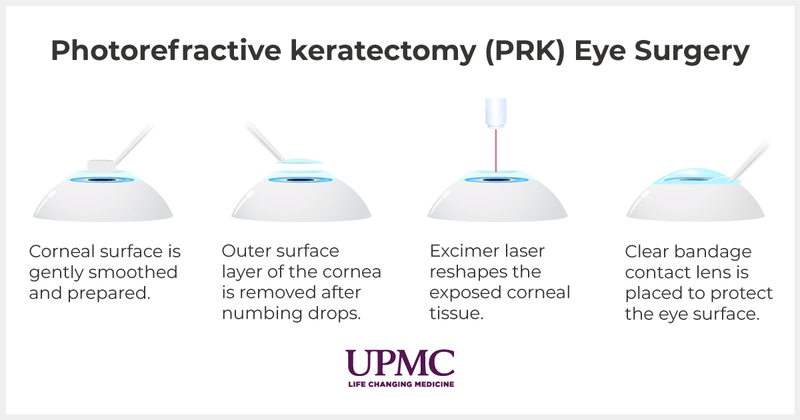
You will be awake for your PRK surgery. Your ophthalmologist will use drops to numb your eyes and place an eyelid holder to keep you from blinking. Then they will remove the outer layer of your cornea, called the epithelium, with a brush.
Finally, your ophthalmologist will use a laser to reshape your cornea.
Recovery after PRK
When the surgery is complete, your doctor will place a contact lens that acts like a bandage on your eye. You will likely have some pain, which you can control with over-the-counter pain medication. Your doctor will also give you special eye drops.
Because the outer layer of your cornea is removed during PRK, it will need time to grow back and heal. This means you will have a longer recovery period than with other types of laser vision surgery. You will need to wear sunglasses whenever you go outside, and you will likely need to take time off from work.
Your particular case may vary, but it typically takes about a week for the cornea layer to grow back. During that time, your vision should improve a little each day. However, it may be a month or more before you achieve optimal vision.
When to call your doctor about PRK complications
You should call your doctor if you experience any of the following symptoms after PRK:
- Fever.
- Loss of vision.
- Pain that cannot be controlled with pain medication.
- Swelling around the eye.
- Yellow or green discharge from the eye.
What’s the outcome of PRK?
According to the American Academy of Ophthalmology, 9 out of 10 people who undergo PRK end up with 20/40 vision. That means you will be able to see an object clearly from 20 feet away that someone with 20/20 vision can see clearly from 40 feet away. So, your vision will be just a little worse than is normal or optimal.
You may still require contacts or glasses for some tasks, such as reading or driving at night.
PRK has some benefits over other types of laser vision surgery:
- It can be performed on people with thin corneas.
- It does not require a corneal flap.
- It is less likely to lead to dry eye issues.
However, it does have a longer recovery time. You should speak with your ophthalmologist about the risks and benefits.
Questions to Ask Your Doctor
- How does the PRK procedure work?
- How is PRK different from LASIK?
- Am I a good candidate for PRK eye surgery?
- Is PRK a good option for people with thin corneas?
- What is recovery like after PRK surgery?
By UPMC Editorial Staff. Last reviewed on 2026-10-30.