What Is SMILE?
Small incision lenticule extraction, or SMILE, is a type of laser vision surgery. It is used to treat vision problems that are caused by refractive errors. That’s when your eye doesn’t bend light properly, creating blurred vision.
SMILE can correct nearsightedness and astigmatism caused by refractive errors, reducing the need for contacts or eyeglasses. You may still need to wear corrective lenses for certain tasks, like reading or driving at night.
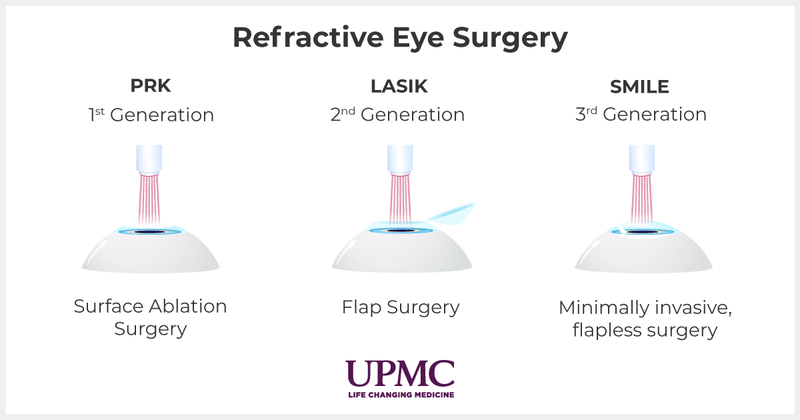
Unlike other types of laser vision surgery, SMILE does not require the ophthalmologist to create a corneal flap or to lift a piece of corneal tissue to access the tissue below. This may appeal to people with active lifestyles, as there is no flap that could be dislodged later.
SMILE is also less likely to cause dry eye symptoms.
Conditions we treat with SMILE
SMILE can be used to treat eye conditions caused by refractive errors, including:
- Astigmatism — When your eye is not evenly rounded. To be a candidate for SMILE, you should have less than 3 diopters of astigmatism.
- Myopia, or nearsightedness — When you have difficulty seeing things that are far away. To be a candidate for SMILE, your prescription must fall between -1 and -10.
Why Would I Need SMILE?
SMILE is an elective surgery that can correct nearsightedness and astigmatism. You may choose to undergo SMILE to improve your vision and reduce the need for contacts or glasses. It’s important to remember that you may still need to wear corrective lenses for some tasks, like reading or driving at night.
SMILE can treat higher refractive errors, or prescriptions, than LASIK, making it an option for those who are very nearsighted. It is also less likely to cause or aggravate dry eye issues.
Is SMILE right for me?
SMILE is best for those over 22 years old with healthy corneas and no change in prescription in the past year.
You may not be a candidate for SMILE if you:
- Are pregnant or nursing.
- Have a cataract that affects your vision.
- Have a disease that affects healing.
- Have advanced glaucoma.
- Have a history of eye disease or eye surgery.
- Have a history of eye infections.
- Have corneal scars.
- Have uncontrolled diabetes.
Alternatives to SMILE
Laser-assisted in situ keratomileusis (LASIK) surgery
In LASIK vision surgery, the ophthalmologist uses a laser to remove a thin layer of tissue from the cornea. This reshapes the cornea so that it can bend light properly. It is usually used to correct nearsightedness, but it also can be used to correct farsightedness or astigmatism.
While LASIK is an effective surgery with a short recovery time, it requires the ophthalmologist to create a corneal flap, or to lift a piece of corneal tissue to reshape the tissue beneath. The flap settles back into place after the surgery, but it can become dislodged. For that reason, LASIK may not be right for highly active people.
Because LASIK also removes a thin layer of the cornea, it may not be right for people who have very thin corneas.
Photorefractive keratectomy (PRK) surgery
In this type of vision surgery, your ophthalmologist removes the very top layer of the cornea and then uses a laser to reshape it so it can bend light properly. It is used to treat nearsightedness, farsightedness, and astigmatism.
Because PRK does not require a corneal flap, it may be a better option than LASIK for those who are highly active or have thin corneas. However, PRK has the longest recovery time of the laser vision surgeries. It can take a week for the cornea to heal and more than a month to achieve optimal vision.
What Are the Risks and Complications of SMILE?
As with any surgery, SMILE comes with the possibility of risks and complications.
The most common include:
- Debris where the disc was removed.
- Glare and halos around lights, particularly at night.
- Infection.
- Inflammation.
- Over- or under-corrected vision.
If SMILE surgery does not adequately correct your vision, it cannot be repeated. Instead, you will need to have PRK surgery to make any adjustments.
What Should I Expect From SMILE?
Before: How to prepare for SMILE surgery
Before you decide on SMILE surgery, you should discuss your vision goals with your doctor. While SMILE is effective at treating nearsightedness and astigmatism, it cannot treat farsightedness.
If you choose SMILE, your ophthalmologist will test your vision to ensure it is within the range that can be corrected with SMILE and to check for any other eye problems. They will also measure and map the surface of your cornea to plan for surgery.
How long does SMILE surgery take?
The procedure takes less than five minutes per eye.
During your SMILE surgery
You will be awake for your SMILE surgery. Your ophthalmologist will use drops to numb your eyes and place an eyelid holder to keep you from blinking.
A suction ring lifts and flattens the cornea so your ophthalmologist can use a special ultrafast laser, called a femtosecond laser, to sculpt a disc-shaped piece of tissue under the cornea’s surface. This disc is called a lenticule.
Your ophthalmologist will then use the laser to make a tiny incision in the cornea and pull the lenticule out through that incision. The removal of the lenticule is what reshapes the cornea.
Recovery after SMILE surgery
Your vision may be slightly blurry after surgery, but it will improve over the next few days and weeks as you heal. You should use the special eye drops your doctor prescribes and avoid getting water in your eyes.
You should be able to resume normal activities after a day or two.
When to call your doctor about SMILE complications
You should call your doctor if you experience any of the following symptoms after SMILE:
- Fever.
- Loss of vision.
- Sudden and severe eye pain.
- Swelling around the eye.
- Yellow or green discharge from the eye.
What’s the outcome of SMILE?
According to a study published in Scientific Reports, 88% to 98% of eyes were corrected within 0.5 diopters of the targeted prescription and within 1 diopter of the targeted astigmatism. A different study reported that 61% to 96% of patients achieved long-term 20/20 vision.
SMILE is less likely to cause dry eye issues because it is less disruptive to the corneal surface than other laser vision procedures.
Questions to Ask Your Doctor
- How does the SMILE procedure work?
- How is SMILE different from LASIK?
- Am I a good candidate for SMILE eye surgery?
- Is SMILE a good option for people with dry eyes?
- What is recovery like after SMILE surgery?
By UPMC Editorial Staff. Last reviewed on 2026-10-30.