What Is Liver Surgery for Living Donors?
Living-donor liver surgery happens when a doctor surgically takes a part of a healthy liver from a living donor to replace a damaged liver in a recipient.
Living-donor liver transplant procedures are possible because the liver is one of the only organs in the human body that can regenerate or regrow. About eight to 10 weeks after the living-donor liver transplant, the liver will regrow to full size and function in both the donor and the recipient.
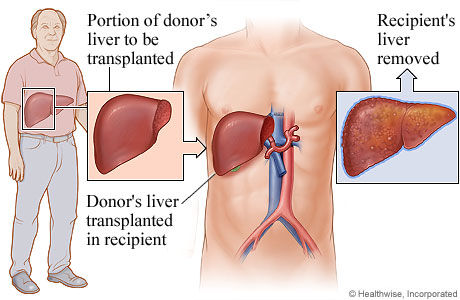
Living-donor liver transplant
For a living-donor liver transplant, a healthy person donates a portion of their liver to the transplant recipient. The recipient's liver is removed and replaced with this part of the donor's liver. The recipient's and donor's surgeries are carried out at the same time in different operating rooms.
Both the portion of the liver remaining in the donor and the portion donated will grow back to normal size.
© 2016-2025 Healthwise, Incorporated. This information does not replace the advice of a doctor.
What are the types of liver surgery for living donors?
At UPMC, our surgeons specialize in minimally invasive liver surgery. In most cases, they can perform living-donor liver surgery using laparoscopic and robotic technology. This reduces recovery time and the discomfort the donor experiences.
Laparoscopic donor partial hepatectomy
This approach uses small scopes and instruments inserted through three to four very small incisions to remove a portion of the liver.
The smaller incisions reduce pain and discomfort for the donor, resulting in a shorter hospital stay and a rapid return to normal activity. Most donors are ready to return to work and normal activity within four weeks of surgery.
Robotic donor partial hepatectomy
UPMC surgeons have access to advanced technologies and robotic systems to assist with living-donor liver surgery. Using a robotic system instead of traditional surgical techniques or open surgery allows surgeons to perform minimally invasive living donor surgical procedures with increased precision, less tissue damage, and better visualization — providing easier access to areas that are hard to reach.
Why is becoming a living liver donor important?
In 2024, there were more than 600 living-donor liver transplants performed in the United States. Receiving a living donation decreases a person's wait time on the national transplant waiting list. Additionally, a liver from a living donor can begin functioning immediately, leading to better overall results post-surgery.
What are the benefits of a living-donor liver transplant?
There are many benefits of living liver donation, including:
- Living donor transplant helps save the lives of people with end-stage liver disease. Furthermore, it increases the number of livers available for people on the transplant waiting list.
- Living-liver donors can feel good knowing that they've had a huge impact on another person's life.
- Living liver donors and transplant recipients can schedule surgery at a time that works for both people.
- Flexible scheduling allows the transplant to occur sooner. This can save valuable time spent on the liver transplant waitlist and reduce the risk that the recipient’s liver disease will get worse.
- Because they are receiving a portion of a healthy donor's liver, recipients typically have improved long-term outcomes and quicker recovery times.
Why Would I Need Liver Surgery for Living Donors?
You would need liver surgery for living donors if you decide to donate a portion of your healthy liver to someone in need of a liver transplant, such as a family member, friend, coworker, or even a stranger.
Who’s a candidate for liver surgery for living donors?
Candidates for living liver donation must:
- Be between the ages of 18 and 60.
- Be in good physical and mental health.
- Have a BMI less than or equal to 32.
- Not engage in active or ongoing drug or substance use.
- Have an unselfish desire to contribute to another person’s life in a healthy way.
- Be in general good health with no history of:
- Liver disease, including cirrhosis and hepatitis.
- Significant diseases involving other organs, such as the lung, kidney, and heart.
- Pulmonary hypertension.
- HIV.
- Active malignant cancers
You do not need to have a compatible blood type to become a living-liver donor at UPMC.
Who is not eligible to be a living liver donor?
The following may prevent a candidate from being eligible for a living donation:
- Abnormal glucose levels with a fasting value greater than 100 or a two-hour tolerance greater than 140.
- Abnormal results from any requested testing.
- Blood pressure outside an acceptable range.
- History of gestational diabetes, cancer, or autoimmune disorder such as lupus.
- Infections or infectious diseases identified on work-up, such as hepatitis or tuberculosis.
- Less than age 18 or over age 65.
- Social or financial concerns that are identified by the transplant team.
- Active substance abuse, such as alcohol and drug use.
- A severe, untreated psychiatric disorder.
How can I become a living liver donor?
To become a living donor, you do not have to be related to the recipient. Your liver will regrow to its original size in about three months post-donation. Our team understands that every transplant is different, and we will be there with you every step of the way.
Living-donor liver paired exchanges
UPMC offers living-donor liver paired exchanges.
In a paired exchange, a living donor and recipient whose blood types are incompatible are matched with another incompatible living donor and recipient. The living donors agree to swap, or exchange, recipients. This swap allows both recipients to receive a portion of a compatible liver.
What Are the Risks and Complications of Liver Surgery for Living Donors?
Surgery of any kind carries basic risks. Keep in mind that UPMC's renowned liver transplant surgeons have experience with complex cases. Our knowledge and expertise allow us to reduce the risks of complications during liver transplant surgery.
Complications during living-donor liver surgery are rare.
However, somerisks of living-donor liver surgery may include:
- Bile leakage — Occurs in a small subset of living-liver donors and most often resolves itself. Doctors can also aid the healing process by placing a tube in the liver.
- Infection — Some living-liver donors may get an infection at the site of surgery. If this happens, our transplant team will monitor your condition to reduce health issues.
- Organ damage or other problems — Living-liver donation can also cause organ damage, further complications, or even death in very rare cases.
At UPMC, our transplant team will discuss the benefits and risks of living-liver donation during your pre-donation evaluation.
What Should I Expect From Living Donor Liver Surgery?
When you come to UPMC as a potential liver donor, our team of transplant experts will make sure that organ donation poses the least possible risk to you and the transplant recipient.
The steps in the living-liver donation process include:
- Pre-liver-donation evaluation.
- Surgery to remove part of your liver.
- Post-liver-donation recovery.
Pre-liver-donation evaluation
Before scheduling living-donor liver surgery, you will undergo a thorough evaluation. This will ensure that you have no conditions or concerns that would cause special risks during the surgery and that the transplant recipient will benefit from the donated portion of your liver.
During your pre-donation evaluation, your care team will schedule you for medical tests or consults with other experts.
Your liver transplant coordinator will provide you with a list of these tests and any special instructions about:
- Avoiding caffeine.
- Eating or drinking before testing.
- Taking your normal medications.
- The types of clothes or shoes you should wear to your test.
You will also receive details about what to expect from liver donation surgery, including recovery and ways to help you return to daily activities.
You will have the chance to ask questions at any point during your pre-donation evaluation. Our team will make sure your care partner and you understand all potential liver donation risks and the donation and recovery process. Both you and your care partner need to recognize the commitment required to see the process through to completion.
Your living donor care team
Throughout the living-donation process, donors interact with a multidisciplinary team of liver transplant experts, including:
- Financial coordinators — Review your insurance coverage for donation and post-donation medications. They may also be able to recommend additional coverage to help reduce your out-of-pocket expenses after donation.
- Hepatologists (liver specialists) — Diagnose, treat, and manage liver conditions.
- Living donor coordinators — Guide living donors through all phases of the donation process. The living donor coordinator is your resource for all questions and concerns about living donation.
- Nurse practitioners — Work closely with doctors, nurses, and staff to extend the care provided by doctors. Nurse practitioners participate in the care of liver transplant recipients and living donors.
- Pharmacists — Pharmacists assist with medication management and medication education before and after donation.
- Research coordinators — Transplant nurses who coordinate and oversee patients who participate in research studies and clinical trials.
- Social workers — Help you review your social, financial, and support systems to make sure that your donation will be a successful experience. They are also available after your procedure to help you get the medicines you need and address other social concerns you may have.
- Surgeons — Perform living-donation liver surgeries at UPMC Montefiore in Pittsburgh, Pa.
This team will determine if you are a candidate for living donation.
Independent living-donor advocate
If cleared to donate an organ, donors will be assigned an independent living-donor advocate to act on their behalf. The living-donor advocate helps to ensure the donor is fully aware of what it means to be a living donor and understands the risks of the donation surgery.
The living-donor advocate will voice any of the donor’s concerns to the multidisciplinary transplant team and will determine that the donor’s decision is fully informed.
Living donor mentors
UPMC offers the opportunity for potential living donors to speak with someone who has already been a living donor. If you’d like to connect with a mentor who can share their personal experience with you, please reach out to your transplant coordinator or living donor liaison.
Who pays for living-donor liver surgery?
Medical costs related to liver donation are typically covered by the recipient’s insurance. Before your evaluation, a UPMC transplant credit analyst will financially approve you for living-donor liver surgery. You will then receive a UPMC living donor insurance card, which includes information about registration and billing.
Surgery to remove part of your liver
The transplant surgeons at UPMC use minimally invasive laparoscopic and robotic surgical techniques to perform donor surgery. This reduces recovery time and the discomfort the donor experiences.
Before: How to prepare for living-donor liver surgery
Your living-donor liver transplant nurse coordinator will give you details on how to prepare for your surgery. We ask all living donors to take basic health measures to ensure surgery goes smoothly and lessens the recipient’s risk of rejecting your liver.
You will be asked to stop:
- Oral contraceptives — Donors should stop oral contraceptives around four weeks before living donation to prevent blood clots after surgery. We strongly advise you to use other forms of birth control during this time.
- Smoking — If you’re a light smoker, stop smoking at least one month before your liver donation surgery. Because smoking can add risks to surgery, people who smoke heavily do not make ideal organ donors.
- Using alcohol or drugs — Before surgery, you must not consume alcohol or drugs. We also ask you to inform your living-donor transplant nurse coordinator of any medications you are taking.
The day of surgery
On the day of living liver donation surgery:
- You will be admitted to the Ambulatory Surgery Center on the sixth floor of UPMC Montefiore.
- You will meet with the transplant surgeon and anesthesiologist to ask any questions before the operation.
- Your care partner and loved ones can wait in the surgery center waiting room. Your living-donor liver transplant coordinator will update them on the progress of your surgery.
How long does living-donor liver surgery take?
Living-donor liver surgery takes five to seven hours.
During your liver donation surgery
During living-donor liver transplant surgery, you will have a partial hepatectomy — the surgical removal of a part of the liver.
After you are under general anesthesia, your surgeon will:
- Make an incision across your abdomen to safely locate and remove the appropriate portion of the liver.
- Remove anywhere from 25% to 65% of your liver, depending on the size of the recipient.
- Remove your gallbladder since it is attached to your liver.
After your surgery begins, a second team of surgeons starts to operate on the liver transplant recipient.
The evaluation process does not stop when the surgeries begin, but will continue throughout.
The transplant team may stop surgery if, at any point, they think:
- You're at risk or in any danger.
- Your liver isn't suitable for the transplant.
Before you leave the OR, surgeons will place drains in your abdominal cavity. These let fluids drain and will stay in place for up to five days while you heal after surgery.
Recovery after liver donation surgery
Your hospital stay
Following living-donor liver surgery, you will move to an inpatient post-surgery unit to make sure you do not need further treatment. From there, you will transfer to a transplant recovery floor where you will stay for about one week before going home.
Returning home after liver donation surgery
Liver donors can typically return to an independent life of showering, getting dressed, and doing other simple daily activities when they arrive home after discharge. This is usually one week after surgery.
If you live far from UPMC Montefiore, we may ask you to stay for a few more days at a nearby hotel.
During the liver donation recovery process, you will need to:
- Ask someone to handle strenuous household duties and child care.
- Remain hydrated.
- Consume a healthy, balanced diet to heal and prevent constipation.
Will I need to take any medication after donating a portion of my liver?
Medications to control your pain and some other routine post-operative medications may be needed during your hospital stay, but it is unlikely you will need medication after you leave the hospital.
Your follow-up appointments
While you're recovering at home, your transplant team will schedule follow-up appointments to monitor your health and recovery.
You will need to return to UPMC Montefiore for clinic visits at the following times after your liver donor surgery:
- The first and fourth weeks.
- Three months.
- Six months.
- One year.
- Two years.
If you cannot return to our transplant clinic in Pittsburgh, you should visit your primary care physician for a physical exam.
The transplant team is happy to address any questions or concerns you may have about your surgery. However, you should talk to your primary care physician about any issues unrelated to your surgery.
It's important to continue to maintain your health and relationship with your primary care physician, and to have routine yearly physical exams.
How long does it take for your liver to regenerate after donation?
In a few months after surgery, your liver will regenerate to its full size and return to its pre-donation level of health. The transplant recipient's new liver will grow to full size as well, leaving both of you with healthy, functioning livers.
When to call your doctor about complications
You should let your surgeon know if you have:
- A fever of more than 100.0°F.
- Difficulty breathing.
- Numbness, tingling, pain, swelling, or weakness in your leg.
- Pain, redness, bleeding, drainage, or increased swelling at your treatment site.
- Severe pain that does not respond to medication.
What’s the prognosis after liver surgery for living donors?
Most living liver donors can return to normal activities within a few weeks of their donor procedures and experience no long-term complications.
Why Choose UPMC for Liver Surgery for Living Donors?
When you choose UPMC for liver surgery for living donors, you will receive:
- Access to experienced, board-certified specialists — UPMC’s liver surgeons have pioneered minimally invasive (laparoscopic) liver surgery and have performed this technique more than 250 times — making them one of the most experienced teams in the United States.
- Expert care for complex cases — Our program is one of the oldest and largest in the United States. Since the program's inception in 1981, we have performed more than 6,000 adult liver transplant procedures, including more than 1,000 combined adult and pediatric living-donor liver transplant procedures. This experience allows us to treat patients with complex liver conditions, including those with advanced liver cancer.
- Personalized liver transplant care — From thorough evaluation to world-class treatment, we provide a patient-centered approach to care throughout the entire transplant process. Your dedicated transplant team will guide and support you each step of the way.
Learn More About Living-Donor Liver Transplant
Living-liver donation can help more than 14,000 people currently on the waiting list.
Living donors can make a life-changing difference in many lives. UPMC's liver transplant team is dedicated to helping living donors and ensuring that they receive the care and assistance they need during the process.
UPMC's HealthBeat Blog: