



As a nurse in the neurosurgery office at UPMC Williamsport, Brittany W. saw how neuro care benefited those she helped treat. But she had no idea that she would one day experience that same care firsthand.
Brittany, 40, of Milton, Pa., has struggled with fatigue, chronic migraines, and pain for most of her life. She would blame her symptoms on polyendocrine metabolic ovarian syndrome (PMOS) and chronic fatigue syndrome — two conditions she’s struggled with for years.
“I was tired all the time,” Brittany says. “Then I had my daughter when I turned 30. I had lots of complications with her, and I just never really bounced back from that.”
After giving birth, Brittany had back surgery and struggled with kidney issues. Then, in December 2024, her health issues got even worse.Worsening Symptoms, Ongoing Pain
After fighting constant fatigue, severe headaches, and ongoing nausea, Brittany saw a new primary care provider (PCP) in February 2025. To her surprise, her PCP recommended an MRI of her brain.
The diagnostic scan identified the source of her pain — a Chiari I malformation. This neurological disease causes your brain to leak into your spinal cord. It can cause headaches, dizziness, and sleep issues — symptoms that matched Brittany’s health problems.
A Chiari malformation isn’t always dangerous. Many people are born with Chiari malformations and are asymptomatic. They may never know they have the malformation.
But for Brittany, the condition was serious.
The First Surgery
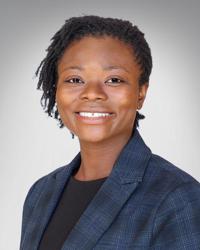
By May 2025, Brittany was preparing to undergo her first surgery at UPMC Williamsport to repair the Chiari malformation. That's when she met with Nancy Amma Abu-Bonsrah, MD, a neurosurgeon with the UPMC Neurological Institute - Williamsport.
Brittany says Dr. Abu-Bonsrah treated her with kindness and compassion. She maintained open and honest communication with Brittany and her family, keeping them informed about her surgery. When Brittany called her parents, who live in New York State, Dr. Abu-Bonsrah updated them directly on Brittany’s condition.
Brittany felt open to ask questions, knowing Dr. Abu-Bonsrah would provide sincere, helpful answers.
In May 2025, Brittany had surgery to remove the Chiari malformation. She hoped it would solve her problem, but when she got home, Brittany wasn’t herself. She remembers feeling anxious, having blackouts, and mumbling when she tried to speak.
"My husband said I was crying all the time," Brittany says. "At night I was getting up and walking. Something was wrong, but I couldn’t tell him what.”
After only a few days home, Brittany’s husband became so worried about her symptoms that he called 911. When paramedics arrived and asked Brittany what was wrong, she couldn’t find the words to answer them.
Admitted to the hospital again, Brittany received treatment for pneumonia. But she was only back home for a week before she was back in the hospital with a sepsis diagnosis. After doctors gave her antibiotics, she was able to return home — but unfortunately, not for good.
Although Brittany hoped she’d reached the end of her hospital visits, her health issues continued to worsen.
Complications Bring More Neuro Treatments
In June 2025, Brittany noticed a lump on the back of her neck. As a nurse, she self-diagnosed it as a seroma, meaning a fluid-filled sac that can form under the skin after surgery.
“Most of the time they resolve on their own,” she says. “Of course, mine did not.”
Soon after, Brittany began losing control of everyday functions. She couldn’t walk, feed herself, or use the bathroom on her own. She slept for three days straight.
Her family grew increasingly worried. By July, she was back in the hospital, where she found out she needed a second surgery to treat the Chiari malformation.
When Brittany woke up after surgery, Dr. Abu-Bonsrah told her that she required one more surgery. She needed a shunt placed in her head to drain fluid and decrease pressure.
After the second surgery, Brittany remembers Dr. Abu-Bonsrah helping her with her bandages and talking her through the next steps of her treatment. Her care was “professional and supportive,” Brittany says.
“She always said ‘we,’” she says. “It was never just myself. As a patient, that’s great to hear because you can feel like, ‘the doctor treated me and here I am to pick up the pieces and move on.’
"But this was definitely not something that was easy to move on from.”
Precise Treatment, Compassionate Care
Through Brittany’s long and intricate neurosurgery treatment, Dr. Abu-Bonsrah was "wonderful."
“Every time I was in the emergency department, she [Dr. Abu-Bonsrah] was there,” Brittany says. “Every time we needed something, she would call back. Every time I was in the hospital, she was there at least twice a day.”
When describing her relationship with Dr. Abu-Bonsrah, Brittany can't help but get choked up. Her neurosurgeon always went the extra mile and showed investment in Brittany’s recovery.
“It was never cold bedside manner,” Brittany says. “Even now, she’ll always hug me and ask me how I’m doing. Sometimes, you feel like just a number, but she definitely did not make me feel like that.”

Life in Recovery
Brittany is now back to full-time nursing. Her once-frequent health care appointments have decreased to yearly checkups. She keeps an eye out for symptoms in between visits.
Although her life has transformed for the better, Brittany knows that her recovery process won’t be linear.
“This is going to be something I have to monitor and deal with for the rest of my life,” Brittany says.
Still, she’s happy to have returned to everyday tasks, even ones she once took for granted. Chores like shoveling snow and mowing the lawn are simple now, but impossible not too long ago.
In the summer of 2026, she vacationed with her family for the first time in six years. She, her husband, and their 10-year-old daughter enjoyed time at Knoebels Amusement Resort in Elysburg, Pa.
Despite the difficult journey, Brittany says, "I couldn't be the mom, the employee, or the wife that I want to be without it."
