













If you can see road signs clearly, but you've struggled to focus on a book or laptop screen since you were young, you may have hyperopia. Also known as farsightedness, hyperopia is a vision problem that you may have since childhood in which distant objects appear clearer than those up close.
At UPMC, our vision experts treat hyperopia with simple fixes like eyeglasses and contact lenses. For some people, laser surgery and other procedures may be an option.
On this page:
What Is Hyperopia?
Doctors define hyperopia as an eye focusing disorder, not an eye disease. It’s a refractive error, which means your eye does not bend light (refract) properly. You've probably had it from a young age.
If you’re farsighted, you can focus easily on objects at a distance (street signs, trees). But objects closer to you (a book, laptop screen) look fuzzy. Your eye muscles must work harder than normal to focus, leading to eye strain and fatigue.
Another condition that produces similar symptoms — but has a different cause — is presbyopia.
Presbyopia is a common eye condition that usually begins when you're in your 40s. It is the natural, age-related loss of the ability to focus on close-up objects. It happens when your eye’s lens gradually loses its flexibility, making it harder to focus on close objects.
How does hyperopia affect vision?
To understand what hyperopia is and how it affects vision, it’s important to know how vision works.
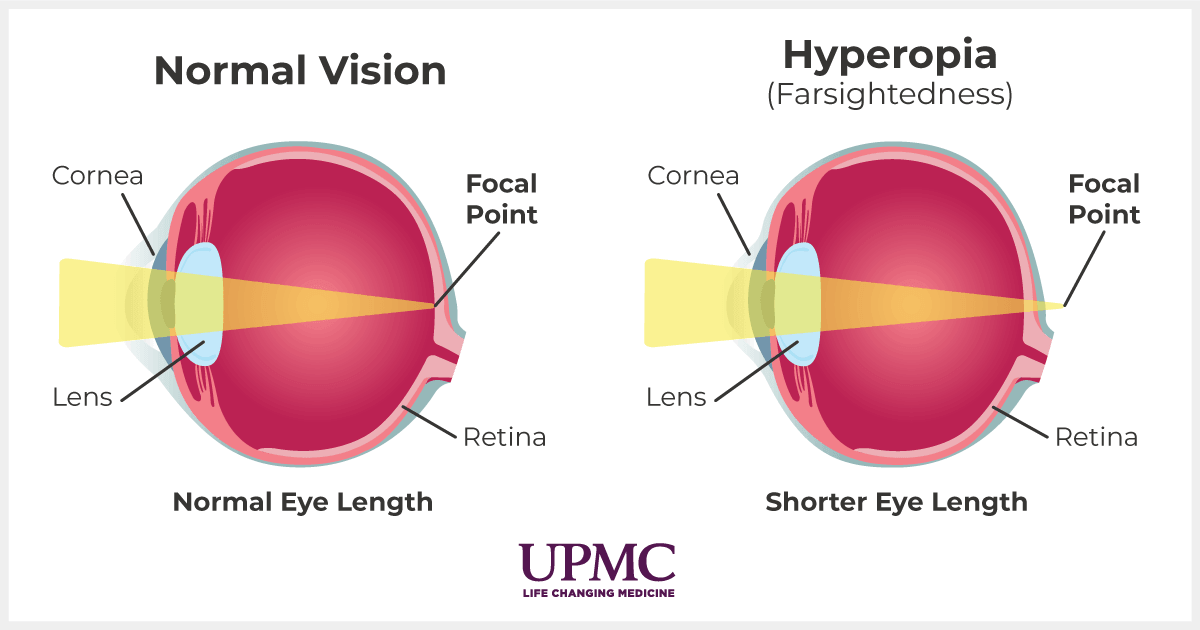
First, light passes through the tears, cornea, and lens at the front of the eye. The lens focuses light onto the retina, the light-sensitive lining at the back of the eye. The retina contains light-sensing cells that send signals to your brain, allowing you to see.
If you have a refractive error, the shape of your eye prevents light from landing in the right place.
Hyperopia occurs when your eyeball is too short from front to back, or the cornea is too flat. The light entering the eye gets focused too far back. It lands behind the retina instead of on it.
This change affects your vision and makes close objects look blurry. The shorter your eyeball is, the more farsighted you are.
How common is hyperopia?
Being farsighted is less common than being nearsighted, but it is still a common condition.
According to the National Eye Institute, hyperopia affects about 5% to 10% of adults in the U.S.
Most babies are born farsighted, but as they age, they grow out of it. That’s because as a child gets older, the eye changes shape and gets longer. Their mild hyperopia gets reduced or goes away altogether.
However, children with higher-than-usual levels of hyperopia should see an eye doctor. If left untreated, it can lead to worse eye conditions.
What causes hyperopia?
Doctors usually don’t know the cause of hyperopia.
Some genetic disorders may make you more prone to being farsighted.
If one of your parents had hyperopia, you may too. But many children who have hyperopia are born to parents with normal vision.
Hyperopia risk factors
- Having one or both parents with hyperopia – much more common.
- Having one of the following genetic disorders-rarely:
- Achromatopsia.
- Down syndrome.
- Fragile X syndrome.
- Having one or both parents with hyperopia.
Complications of hyperopia
Left untreated, farsightedness can lead to:
- Difficulty concentrating.
- Excessive tearing.
- Eye strain.
- Frequent blinking.
- Headaches.
- Problems reading.
- Trouble with hand-eye coordination.
Severe hyperopia in children can lead to more serious problems.
Untreated, farsightedness can lead to:
- Amblyopia (lazy eye).
- Strabismus (crossed eyes).
- Vision loss.
How can I reduce risks of hyperopia?
There’s no way to completely prevent farsightedness.
But overall, you can help keep your eyes healthier if you:
- Eat a well-balanced diet with plenty of fruit and leafy greens — These foods have nutrients essential for eye health.
- Go to the eye doctor — Everyone should have regular eye exams. The frequency varies by age, but your provider will tell you how often you should schedule checkups.
- Protect your eyes from the sun — Ultraviolet (UV) rays can damage your eyes. Put on your sunglasses whenever you go outside.
- Take breaks from your screens — Resting your eyes after using your phone or computer is a good vision comfort routine.
What Are the Signs and Symptoms of Hyperopia?
Common signs of farsightedness in everyday life include:
- Blurry vision when reading or doing close work.
- Burning, aching eyes.
- Difficulty reading.
- Eye crossing, especially in young children.
- Eye strain.
- Fatigue.
- Headaches after reading or doing other close work.
- Irritability after a period of concentration.
- Squinting.
When should I see a doctor about my hyperopia symptoms?
If your farsightedness challenges — blurry vision up close and headaches — are bothering you daily, you should see an eye doctor.
Your child’s pediatrician will check their eyes at well visits. However, if you notice your child showing symptoms of farsightedness, they should see an eye doctor.
How Do You Diagnose Hyperopia?
Health care providers diagnose hyperopia with a thorough eye exam.
Both optometrists and ophthalmologists can diagnose farsightedness. Optometrists specialize in vision problems and eye diseases. Ophthalmologists diagnose eye problems, treat eye disease, and perform eye care, including surgery.
What to expect during your visit
Your eye doctor will ask you about your general health and medical history. Then they will perform an eye exam.
They may dilate your pupils with eye drops to get a better look inside your eye. Dilating eye drops relax the lens inside the eye. This lets doctors get a more accurate measurement of your eyeball.
If your pupils were dilated, you should arrange for someone else to drive you home. You should wear sunglasses when you go outside, as your eyes will be very sensitive to sunlight. It will take several hours for your pupils to go back to normal.
Tests to diagnose hyperopia
In people old enough to read, a provider will have you read letters on an eye chart. The test measures visual acuity (sharpness) and is expressed as a fraction.
The top number is the standard distance (20 feet) at which the test takes place. The bottom number is the smallest letter size that can be read. Normal vision is 20/20.
Your doctor may also use a phoropter, which puts a series of lenses in front of your eyes.
For children too young to read, a device will measure where light is focused inside the eye.
Hyperopia outlook
Hyperopia won’t go away. But there are simple fixes — eyeglasses, contact lenses — to help you see better. For some people, laser eye surgery may be an option.
How Do You Treat Hyperopia?
The goal of treatment for farsightedness is to restore clear distance vision.
There are different ways to help correct hyperopia. You should talk to your eye doctor about your specific needs.
Eyeglasses for hyperopia
Wearing glasses is the most common and easiest way to correct farsightedness.
Contact lenses for hyperopia
Contact lenses fit directly over your eyes and can help correct farsightedness. They become the first refractive surface for light entering the eye. Contacts help focus light onto the right part of your retina, helping you see more clearly.
Your eye doctor can talk to you about whether contact lenses are right for you. If you have certain eye conditions, you may not be able to wear them.
Laser procedures to treat hyperopia
Some people want a more permanent method of improving their eyesight. Laser surgery is a good option in certain instances. Your doctor can talk to you about whether it’s right for you.
During refractive laser surgery, the laser reshapes the cornea, which adjusts the way light travels through it. Some of the most common laser procedures are:
- LASIK (laser-assisted in situ keratomileusis).
- PRK (photorefractive keratectomy).
- SMILE (small incision lenticule extraction).
Refractive lens exchange for hyperopia
If your corneas are too thin for laser surgery, your eye doctor may recommend a refractive lens exchange. In these procedures, an ophthalmologist removes your natural eye lens and replaces it with an artificial lens.
How effective is treatment?
Every method of treating hyperopia is effective, but each has pros and cons. Your treatment may come down to your and your eye doctor’s deliberation. Some people are comfortable wearing eyeglasses or contacts, while others prefer a more permanent treatment like LASIK. Even if you have LASIK or another laser procedure, you may still need glasses at some point.
How long does it take to recover after surgical treatment for hyperopia?
Many people see improved vision immediately after a LASIK or other refractive eye treatment. It may take some time for your eyes to completely adjust. Full healing can take up to six months.
