











If you squint at the television or road signs and they look blurry — but a book held close looks clear — you may have myopia. Myopia (nearsightedness) is a common condition in which the eye has trouble focusing on objects far away.
At UPMC, our eye experts have years of experience correcting nearsighted vision. Eyeglasses, contact lenses, and refractive surgery (such as LASIK and other procedures) can help restore clear vision.
On this page:
What Is Myopia?
Doctors define myopia as a common eye condition that causes blurry distance vision. Primary symptoms are eye strain and squinting. It usually begins in childhood or adolescence and may be partially inherited from your parents.
What is myopia and why are distant objects blurry?
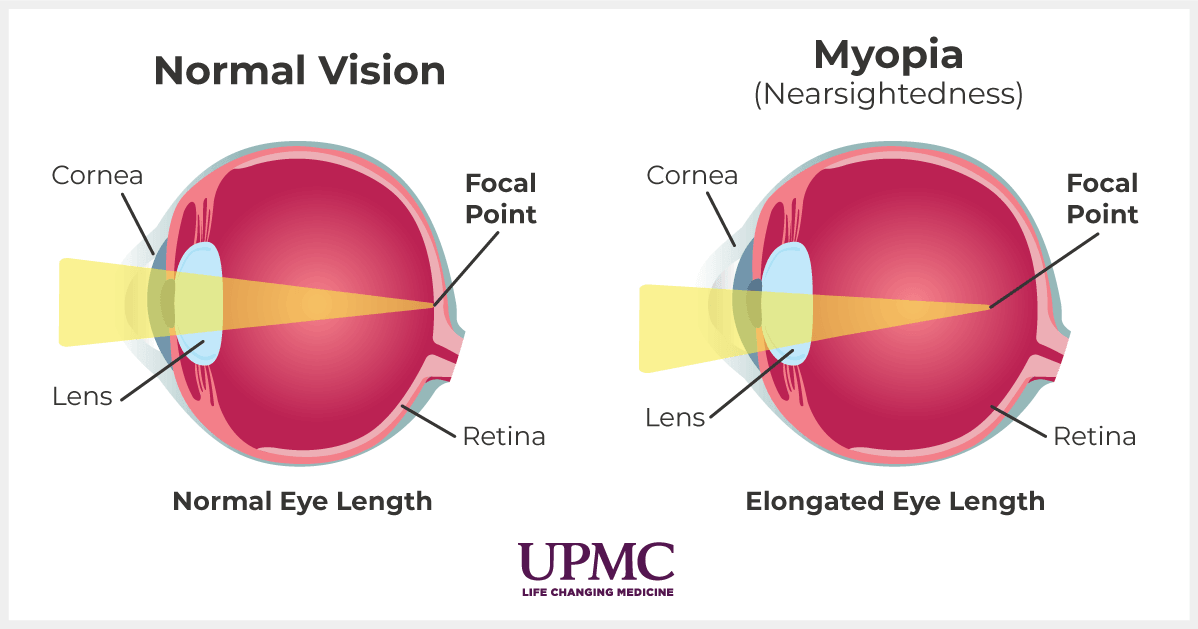
Here’s how vision works: First, light passes through the cornea and lens at the front of the eye. The lens focuses light onto the retina, the light-sensitive lining at the back of the eye. The retina contains light-sensing cells that send signals to your brain, allowing you to see.
Myopia occurs when your eyeball is too long from front to back, or the cornea is too steeply curved. The light entering the eye gets focused too far forward. It lands in front of the retina instead of on it.
This change affects your vision, making distant objects appear blurry. The longer your eyeball is, the more nearsighted you are.
Myopia is not the same as presbyopia. Presbyopia is another common eye condition that usually begins when you're in your 40s. It’s a natural, age-related loss of the ability to focus on close-up objects. Many people can use inexpensive reading glasses to correct presbyopia.
How myopia affects school, work, and everyday activities
Myopia often begins during a child’s school years. The first sign may be your child squinting or having trouble seeing the board or other objects at school.
But myopia can affect you throughout your life. You may have trouble driving, reading faraway signs, or focusing on a movie or television screen.
What are the types of myopia?
Doctors classify myopia by how powerful the lens must be to correct it. They use a measure of lens power called a diopter.
The types of nearsightedness are:
- Mild or low myopia — Less than 3 diopters of myopia.
- Moderate myopia — Between 3 and 6 diopters of myopia.
- Severe or high myopia — More than 6 diopters of myopia. This form of myopia increases your risk of other eye problems. They include a torn or detached retina, cataracts, and glaucoma.
- Pathological myopia — Doctors use this term when high myopia leads to tissue damage in the eye.
How common is myopia?
Myopia is very common, affecting about 30% of the people in the U.S.
Nearsightedness has been on the rise for several decades, according to the American Academy of Ophthalmology. They estimate that nearly half the people in the world will have myopia by 2050. Genetics, lack of outdoor time, and too much screen time may all be factors.
What causes myopia in the eye?
Many people start noticing symptoms of myopia in childhood, often between ages 8 and 12. It often gets worse till around age 20, when it stabilizes. Doctors don’t always know the exact cause of myopia.
It may be a combination of factors, including:
- Eye strain — If you spend hours reading, working on a computer, or playing video games, you’re more likely to develop myopia.
- Genetics — If one or both of your parents had myopia, you have a greater chance of having it too.
- Lack of natural light — Spending too much time indoors in artificial light may contribute to nearsightedness.
- Medical conditions — If you have diabetes or an eye condition such as cataracts, you’re more likely to develop myopia.
Myopia risk factors
- Having Asian heritage — People of Asian descent have a higher rate of myopia than other ethnic groups.
- One or both parents with myopia.
- Spending hours of screen time on phones or computers.
- Spending most of your day indoors.
Complications of myopia
Mild or moderate myopia has few complications.
But severe myopia can lead to other, more serious eye problems, including:
- Bleeding or unwanted blood vessels in your eyes.
- Cataracts.
- Damage to the optic nerve.
- Glaucoma.
- Retinal detachment.
- Vision loss.
How can I reduce risks of myopia?
You may not be able to prevent nearsightedness from developing.
Some pediatric eye doctors prescribe a low dose of atropine to children. It’s an eye drop that may stop or slow the progression of myopia as they get older. Special contacts may also slow myopia in some children.
Limiting screen time may also help slow down the progression of myopia in children.
What Are the Signs and Symptoms of Myopia?
Common signs of nearsightedness in daily life include:
- Eyestrain.
- Feeling tired when driving.
- Headaches.
- Holding objects close to your face to see them.
- In children, poor school performance and eye rubbing.
- Squinting.
- Trouble seeing objects far away.
When should I see a doctor about my myopia symptoms?
You should see an eye doctor if you notice your distance vision getting blurry. Your child’s pediatrician should check their eyes at well visits. However, if you notice your child showing symptoms of myopia, they should see an eye doctor.
How Do You Diagnose Myopia?
Health care providers diagnose myopia with a thorough eye exam. Both optometrists and ophthalmologists can diagnose nearsightedness.
Optometrists specialize in vision problems and eye diseases. Ophthalmologists diagnose eye problems, treat eye disease, and perform eye care, including surgery.
What to expect during your visit
Your eye doctor will ask you about your general health and medical history. Then they will perform an eye exam. They may dilate your pupils with eye drops to get a better look inside your eye.
If they dilate your pupils, you should arrange for someone else to drive you home. You should wear sunglasses when you go outside, as your eyes will be very sensitive to sunlight. It will take several hours for your pupils to go back to normal.
Tests to diagnose myopia
In people old enough to read, a provider will have you read letters on an eye chart. The test measures visual acuity (sharpness) and is expressed as a fraction.
The top number is the standard distance (20 feet) at which the test takes place. The bottom number is the smallest letter size that can be read. Normal vision is 20/20.
Your doctor may also use a phoropter, which puts a series of lenses in front of your eyes.
For children too young to read, a device will measure where light is focused inside the eye.
Myopia outlook
Nearsightedness doesn’t go away. But providers can treat it with eyeglasses, contacts, or surgery. Getting regular eye exams can help catch any potential complications.
How Do You Treat Myopia?
The goal of treatment for nearsightedness is to restore clear distance vision.
There are many ways to manage blurry distance vision. You should talk to your eye doctor about your specific needs.
Eyeglasses and contact lenses for myopia
Wearing corrective lenses is the most common and easiest way to correct nearsightedness. Both glasses and contacts help focus light onto the back of your retina, helping you see more clearly.
Contact lenses fit directly over your eyes. There are different types for different eye problems and lifestyles. Your eye doctor can talk to you about which ones best fit your vision needs.
Laser procedures to treat myopia
Some people want a more permanent way to improve their eyesight. Laser surgery is a good option in certain instances. These procedures can eliminate or reduce your need for glasses.
During refractive laser surgery, the laser reshapes the cornea, which adjusts the way light travels through it. Your doctor can talk to you about whether it’s right for you.
Some of the most common laser procedures are:
- LASIK (laser-assisted in situ keratomileusis).
- PRK (photorefractive keratectomy).
- SMILE (small incision lenticule extraction).
Refractive lens exchange for myopia
If your corneas are too thin for laser surgery, your eye doctor may recommend a refractive lens exchange. In these procedures, an ophthalmologist removes your natural eye lens and replaces it with an artificial lens.
How effective is treatment?
Every method of treating myopia is effective, but all have pros and cons. Your treatment may come down to personal preference. Some people are comfortable wearing eyeglasses or contacts, while others prefer a more permanent treatment like LASIK.
How long does it take to recover after surgical treatment for myopia?
Many people see improved vision immediately after a LASIK or other refractive eye treatment. It may take some time for your eyes to completely adjust. Full healing can take up to six months.
