















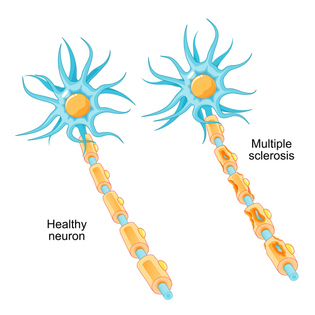
Multiple sclerosis (MS) is an autoimmune disorder that occurs when your immune system mistakenly attacks the myelin sheath, which covers the nerves in your brain and spinal cord.
The myelin sheath protects your nerves and allows electrical signals to travel between your brain and the rest of your body. Damage to the myelin sheath can cause neurological symptoms, including muscle weakness, numbness, vision changes, and memory and cognitive impairment.
UPMC neurology experts provide advanced care for MS, including treatment with medication, rehabilitation therapy, supportive care, and mental health counseling.
On this page:
What Is MS?
Multiple sclerosis is a progressive autoimmune disorder in which the immune system mistakenly attacks the myelin sheath, which covers the nerves in your brain and spinal cord.
The myelin sheath protects your nerves and allows electrical signals to travel between your brain and the rest of your body. Damage to the myelin sheath can cause neurological symptoms, including muscle weakness, numbness, balance and coordination problems, vision changes, and memory and cognitive impairment.
What are the types of MS?
There are four main categories of MS, including:
- Clinically isolated syndrome (CIS) — The first occurrence of symptoms that suggest you may have MS, without fully meeting the diagnostic criteria.
- Primary progressive multiple sclerosis (PPMS) — Symptoms start slowly and get progressively worse, with no periods of relapse or remission.
- Relapsing-remitting multiple sclerosis (RRMS) — Makes up 85% of MS cases and causes flare-ups of new or old symptoms with periods of remission in between.
- Secondary progressive multiple sclerosis (SPMS) — RRMS sometimes progresses to SPMS. Progressive damage to the myelin sheath over time leads to worsening symptoms with no periods of remission.
Rare variants of MS include:
- Balo’s concentric sclerosis — Causes target-shaped areas of demyelination in the brain.
- Marburg variant multiple sclerosis — An aggressive form of MS that progresses rapidly and may lead to death if left untreated.
- Tumefactive multiple sclerosis — Causes large areas of demyelination in your brain that can be mistaken for tumors.
How common is MS?
According to a study funded by the National Multiple Sclerosis Society, approximately 1 million people in the U.S. are living with MS.
What causes MS?
MS occurs when your immune system mistakenly attacks and damages healthy myelin cells. Damage to the myelin sheath that protects your nerves — known as demyelination — causes MS symptoms.
MS risk factors
MS can affect anyone. However, it is more common in females of northern European or African American descent and is often diagnosed between the ages of 20 and 40.
Researchers aren’t sure what increases the risk of developing MS, but believe it could be associated with:
- Genetics and family history.
- Exposure to viruses, such as the Epstein-Barr virus, which causes mononucleosis.
- Exposure to environmental toxins, such as pesticides.
- Low vitamin D levels.
- Smoking and secondhand smoke exposure.
- Childhood obesity.
Complications of MS
Depending on the location of MS lesions, MS can cause symptoms including:
- Difficulty walking.
- Loss of bladder or bowel control.
- Mental health disruptions, such as depression and anxiety.
- Muscle spasms and stiffness.
- Nerve pain.
- Problems with memory and thinking.
- Sexual difficulties.
How can I prevent MS?
There are no proven strategies to prevent developing MS; however, if you are diagnosed with MS, there are treatments available to protect you from disease flare-ups.
What Are the Signs and Symptoms of MS?
Symptoms of MS typically develop between the ages of 20 and 40.
They may include:
- Muscle weakness, often on one side of your face, body, or below your waist.
- Numbness, tingling, or abnormal sensations, often on one side of your face, body, or below your waist.
- Vision changes, such as double vision or vision loss, sometimes due to a condition called optic neuritis.
Depending on the location of MS lesions, you may experience:
- Balance and coordination problems.
- Bladder or bowel control issues.
- Clumsiness.
- Dizziness.
- Fatigue.
- Mood changes.
- Muscle stiffness, or spasticity.
- Problems with thinking, memory, reasoning, and judgment.
- Tremors.
When should I see a doctor about my MS symptoms?
If you have symptoms of MS, you should schedule an appointment with your doctor right away. Early diagnosis and treatment can improve your quality of life and disease trajectory.
How Do You Diagnose MS?
To diagnose MS, your doctor will perform physical and neurological examinations and review your symptoms and medical history. Your doctor may also order tests to confirm your diagnosis or rule out other problems.
What to expect during your visit
During your visit, your doctor will:
- Ask you about your symptoms.
- Order tests.
- Perform a physical and neurological exam.
- Review your personal and family medical history.
Tests to diagnose MS
Our ability to diagnose MS is improving over time; however, it can take time to receive an official MS diagnosis. Your doctor may order tests to gather information or rule out other conditions, including:
- Blood and urine tests — Checks for abnormalities and rules out other conditions.
- Cerebral spinal fluid analysis (spinal tap or lumbar puncture) — Involves inserting a needle into your lower back to collect a sample of cerebrospinal fluid (CSF) for analysis in a lab.
- Evoked potential test — Measures how quickly your brain responds to sights, sounds, and sensations.
- Magnetic resonance imaging (MRI) — Takes images of your brain and spine using contrast dye to look for damaged or abnormal areas.
- Neurological examination — Checks your reflexes, balance, movement, memory, and ability to think.
- Neuropsychological examination — Checks your ability to think, reason, and remember.
- Optical coherence tomography (OCT) — A noninvasive imaging test that uses reflected light to create images of the nerve layers in the back of your eye.
MS prognosis
Currently, there is no cure for MS, and the condition often requires long-term treatment to manage symptoms. However, if symptoms progress, MS may cause disability and other complications.
Can you live a full life with MS?
Yes, most people with MS have a normal life expectancy. As MS symptoms progress over time, you may need to use a cane, walker, or wheelchair to assist with mobility. However, physical therapy can help you maintain strength and mobility, while occupational and cognitive therapy can teach you strategies to help you perform everyday tasks.
How Do You Treat MS?
Currently, there is no cure for MS. The goals of MS treatment are to minimize relapses, slow the progression of the disease, manage symptoms, and reduce your risk of complications. MS treatment options may include:
Medications
Medications may reduce your risk of relapses and slow the progression of the disease.
Medications for MS include:
- Disease-modifying therapies (DMTs) — Long-term treatment that reduces the risk of relapses, slows progression of the disease, and prevents further demyelination. DMTs may be given as injections, IV infusions, or oral medications.
- Relapse management medications — Treat symptoms and flare-ups by suppressing your immune system, reducing inflammation, and slowing demyelination.
Your doctor may also prescribe medications to treat pain, cognitive symptoms, muscle stiffness, urinary symptoms, or mental health concerns.
Acute symptom treatment
Short-term treatments for symptom relapses may include:
- Intravenous immunoglobulin therapy (IVIG) — During IVIG, you will receive an intravenous injection of donor immunoglobulins or antibodies. Immunoglobulins are a natural part of your immune system and protect your body by attacking foreign organisms. Immunoglobulins may prevent your immune system from further damaging your nerves.
- Plasma exchange (plasmapheresis) — Plasmapheresis involves using a machine to separate the liquid part of your blood, called plasma, from your blood cells. Your plasma is then filtered to remove the antibodies that are causing nerve damage before being returned to your body.
Rehabilitation and supportive care
You may receive various rehabilitation therapies to help maintain strength, mobility, and independence. Rehabilitation treatment may include:
- Physical therapy — Improves strength, balance, and mobility using exercises, stretching, massage, electrical stimulation, and other techniques.
- Occupational therapy — Teaches techniques and strategies to help you perform everyday activities, such as bathing, dressing, cooking, and grooming, sometimes with the assistance of a cane, brace, walker, or wheelchair.
- Speech and swallowing therapy — Helps you regain the ability to swallow, chew, and speak. Can also help with cognitive rehabilitation.
Your doctor may recommend other therapies to help manage your symptoms, including:
- Alternative therapies, such as acupuncture or massage.
- Counseling for mental and emotional problems.
- Glasses or medications to manage vision-related symptoms.
Clinical trials
You may be eligible to participate in a clinical trial studying new treatments for MS. Your doctor will let you know if you qualify for a clinical trial.
Why Choose UPMC for MS Care?
When you choose UPMC for MS care, you will receive:
- Multidisciplinary care — Our team of neurologists and autoimmune disease experts will work together to develop a customized treatment plan that reduces your risk of complications.
- Access to advanced clinical trials — Our team participates in national, multicenter clinical trials evaluating new treatment options, allowing you to contribute to research advancing care for autoimmune disorders.
- Seamless, ongoing treatment — If you are diagnosed with MS, our team will develop a follow-up care plan that includes ongoing rehabilitation and symptom management as needed.
- Bench-to-bedside research — We have faculty members who are actively researching MS and other neuroimmunologic disorders.
