















If your fingers get stuck in a bent position, you may have a condition called "trigger finger," also known medically as stenosing tenosynovitis.
Doctors treat trigger finger with watchful waiting, steroid injections, and sometimes, surgery.
On this page:
What Is Trigger Finger?
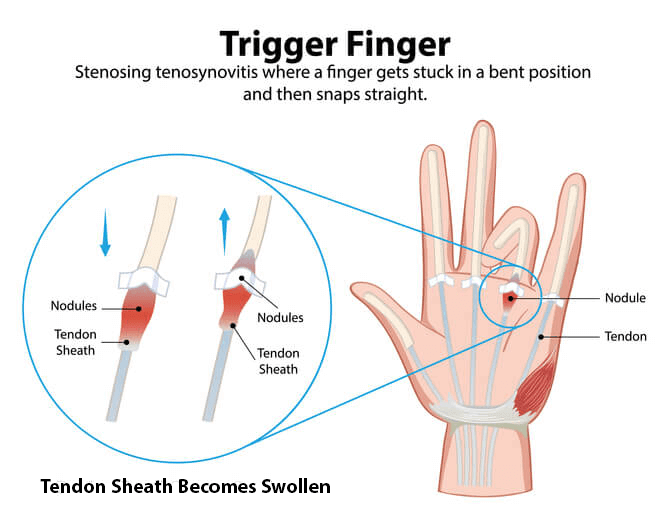
Trigger finger happens when a tendon in your finger gets swollen and catches in a tight tunnel (called a pulley) that holds the tendon close to the bone. When the tendon catches, it causes your finger to get stuck in a bent position or to snap straight when you try to extend it. Sometimes, it can become so severe that you need to use your other hand to straighten the affected finger.
Trigger finger can affect any finger.
What causes trigger finger?
Doctors don't know the exact cause of trigger finger.
How common is trigger finger?
Trigger finger is common, affecting about 3% of the population. Anyone can get it, but it's most often seen in people in their 40s and 50s.
Trigger finger risk factors
- Age – It's more common in infants and as people get older.
- Medical conditions – People with diabetes, rheumatoid arthritis, or thyroid disease are more likely to develop trigger finger.
Complications of trigger finger
Trigger finger can make daily tasks challenging, such as buttoning clothes, using a computer, or gripping a steering wheel. While uncommon, if left untreated for a long time, your finger could stay permanently bent, making it harder to treat later.
What Are the Signs and Symptoms of Trigger Finger?
Symptoms of trigger finger include:
- Clicking or catching – You might notice a clicking, popping, or catching sensation when you bend or straighten your finger.
- Stuck finger – In more severe cases, your finger might get stuck in a bent position, requiring you to use your other hand to straighten it.
- Discomfort – Bending or forcefully straightening your finger can be painful. You might also feel a tender lump in your palm at the base of your finger.
- Changes during the day – The clicking and catching are often worse in the morning and tend to improve during the day.
When should I see a doctor about my trigger finger symptoms?
If you suspect you have trigger finger and it's bothering you, contact a hand specialist or plastic surgeon. Trigger finger is generally easy to treat successfully.
If you suspect you are having a medical emergency, please call 911 or visit your nearest emergency department immediately.
How Do You Diagnose Trigger Finger?
Doctors typically diagnose trigger finger with a physical exam. X-rays or other tests are usually not needed.
What to expect during your visit
Your doctor will ask about your medical history and symptoms. They will examine your hand, checking for:
- Clicking or catching when you bend or straighten your fingers.
- A painful lump in your palm at the base of your finger.
How Do You Treat Trigger Finger?
Your treatment depends on your preference.
Nonsurgical treatment for trigger finger
Most cases of trigger finger are treated without surgery.
Watchful waiting – If your trigger finger isn't causing much trouble, you can simply wait to see if it improves on its own. While waiting, you can take over-the-counter pain relievers or wear a splint to keep your finger straight. However, splinting can sometimes lead to a stiff finger.
Steroid injections – A cortisone injection at the base of your finger can help get rid of trigger finger about half the time. Your finger might feel a bit worse for the first few days after the injection. It takes about two months to see if the injection worked. If you have diabetes, you'll need to monitor your blood sugar more closely on the day of the injection.
Surgical treatment for trigger finger
If you prefer not to wait or try injections, or if injections haven't worked, a minor surgery can be performed to cut the tunnel where the tendon gets stuck. This surgery can be done in an office, surgery center, or hospital. Most people receive a local anesthetic and remain awake.
After surgery, it's important to use your hand for everyday activities right away to prevent stiffness and help with recovery. The incision usually heals in about two weeks. During this time, you should use your hand as normally as possible while protecting the incision.
How effective is trigger finger treatment?
Injections are effective about two-thirds of the time. Surgery is effective almost all the time.
