













Skip to Content
800-533-8762
  • Careers
  • Newsroom
  • Health Care Professionals
  • About Us
  • Contact Us
UPMC
  • Find a Doctor
  • Conditions
  • Services
    • Frequently Searched Services
    • Frequently Searched Services
      Allergy & Immunology Behavioral & Mental Health Cancer Ear, Nose & Throat Endocrinology Gastroenterology Heart & Vascular Imaging Neurosciences Orthopaedics
      Physical Rehabilitation Plastic & Reconstructive Surgery Primary Care Senior Services Sports Medicine Telemedicine Transplant Surgery Walk-In Care Weight Management Women’s Health
      See all Services
    • Services by Region
    • Find a UPMC health care facility close to you quickly by browsing by region.
      UPMC in Western Pa. Western Pa. and New York
      Highlighted Regional Map of UPMC in Central Pa. Central Pa.
      UPMC in North Central Pa. North Central Pa.
      UPMC in Western Md. Maryland & West Virginia
    • See All Services
  • Locations
    • Locations by Type
    • Locations by Type
      UPMC hospitals
      Hospitals
      Physical Therapy
      Physical Therapy
      Urgent care
      Walk-In Care
      UPMC Outpatient Centers
      Outpatient Centers
      UPMC Imaging Services
      Imaging
      Community Health Centers
      Community Health Centers
      See All Locations
    • Locations by Region
    • Locations by Region
      UPMC in Southwest Pa. Southwest Pa.
      UPMC in North Central Pa. North Central Pa.
      UPMC in Northwest Pa and Ny. Northwest Pa. & Western N.Y.
      UPMC in West Central Pa. West Central Pa.
      Highlighted Regional Map of UPMC in Central Pa. Central Pa.
      UPMC in Western Md. Maryland & West Virginia
    • See All Locations
  • Patients & Visitors
    • Patient & Visitor Resources
    • Patient & Visitor Resources
      Patients and Visitors Resources Pay a Bill Classes & Events Health Library International Traveling Patients Medical Records
      Patient Information Patient Portals Privacy Information Shared Decision Making Visitor Information
      Man uses mobile phone
      Pay a Bill
      Nurse reviews medical chart
      Request Medical Records
  • Patient Portals
  • Find Covid-19 updates
  • Schedule an appointment
  • Request medical records
  • Pay a bill
  • Learn about financial assistance
  • Find classes & events
  • Send a patient an eCard
  • Make a donation
  • Volunteer
  • Read HealthBeat blog
  • Explore UPMC Careers
Skip to Content
UPMC
  • Find a Doctor
    • Doctor Search
  • Conditions
    • Search Conditions We Treat
  • Services
    • Frequently Searched Services
      • Heart and Vascular Services
      • Neurosciences Services
      • Orthopaedics Services
      • Primary Care Services
      • Spine Care Services
      • Sports Medicine Services
      • Transplant Services
      • Women's Health Services
      • See all Services
    • Services by Region
      • Find Care in Western Pa
      • Find Care in Central Pa
      • Find Care in North Central Pa
      • Find Care in Western Maryland
    • See All Services
  • Locations
    • Locations by Type
      • Hospitals
      • Walk-In Care
      • Imaging
      • Physical Therapy
      • Outpatient
      • Community Health Centers
      • See All Locations
    • Locations by Region
      • Central Pa.
      • Maryland and West Virginia
      • North Central Pa.
      • Northwest Pa. & Western N.Y.
      • Southwest Pa.
      • West Central Pa.
    • See All Locations
  • Patients & Visitors
    • Patient & Visitor Resources
      • Pay a Bill
      • Classes & Events
      • Health Library
      • International Traveling Patients
      • Medical Records
      • Patient Information
      • Patient Portals
      • Privacy Information
      • Shared Decision Making
      • Visitor Information
      • View All Patients and Visitors Resources
  • I Want To
    • Find Covid-19 updates
    • Schedule an appointment
    • Request medical records
    • Pay a bill
    • Learn about financial assistance
    • Find classes & events
    • Send a patient an eCard
    • Make a donation
    • Volunteer
    • Read HealthBeat blog
    • Explore UPMC Careers
  • Patient Portals
  • Careers
  • Contact Us
  • Newsroom
  • UPMC >
  • Conditions >
  • Brachial Plexus Injury

Brachial Plexus Injury

The brachial plexus is a network of nerves that runs from the bones in your neck into your shoulders. You have a brachial plexus on each side of your body.

A brachial plexus injury stretches or compresses the nerves in your shoulder, arm, and hand. Usually, only one side is affected. Symptoms of a brachial plexus injury can vary from person to person, depending on the severity and location of the injury.

Looking for Brachial Plexus Care?

Related services:
  • Orthopaedics and Sports Medicine.
  • Pediatrics.
  • Primary Care.
  • Plastic Surgery.
  • Rehabilitation.
  • Walk-In Care.
Find a Provider

On this page:

  • What Is a Brachial Plexus Injury?
  • What Are the Signs and Symptoms of Brachial Plexus Injuries?
  • How Do You Diagnose a Brachial Plexus Injury?
  • How Do You Treat a Brachial Plexus Injury?

What Is a Brachial Plexus Injury?

The brachial plexus is the network of nerves around your neck that sends signals from your spine to your shoulders, arms, and hands.

Injury to the nerves of the brachial plexus occurs when they are cut, stretched, or compressed.

In severe cases, trauma or impact can completely tear the nerves away from the spinal cord, leaving your arm paralyzed.
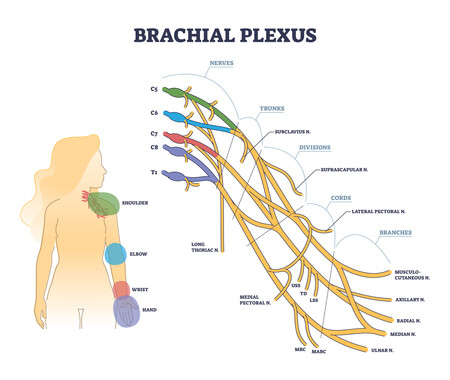
Brachial plexus.

What causes a brachial plexus injury?

The nerves in the brachial plexus are well-protected. It takes a lot of force to hurt them.

Injuries mostly happen after major trauma or impact — such as a motorcycle or car crash, stabbing, or gunshot wound.

Other causes include:

  • Contact sports.
  • Falls or other accidental injuries.
  • Other medical conditions, including tumors and inflammation.
  • Radiation from cancer treatments.

Newborn babies can also sustain brachial plexus injuries during childbirth.

Back to top

Brachial plexus injury risk factors

There are no specific risk factors for brachial plexus injuries. While they usually occur after serious accidents, such as car crashes, other medical conditions can also affect the brachial plexus.

Back to top

Complications of brachial plexus injury

Many less severe brachial plexus injuries heal with time. If a severe brachial plexus injury is left untreated, it may lead to joint stiffness or permanent loss of feeling or arm movement.

How common are brachial plexus injuries?

Brachial plexus injuries are rare, affecting just over one out of every 100 trauma patients. But the risk jumps to nearly one in 20 for people in motorcycle or snowmobile crashes. They often occur along with other major injuries and can be severe, especially when the damage is above the collarbone (near the neck).

In newborns, brachial plexus injuries affect up to four babies per 1,000 births. A common cause is shoulder dystocia, a rare but serious emergency during vaginal deliveries. It happens when the baby's shoulders get stuck after their head has been delivered, usually because their front shoulder is caught behind their mother's pubic bone. Most cases cannot be predicted or prevented.

Back to top

What Are the Signs and Symptoms of Brachial Plexus Injuries?

Symptoms of a brachial plexus injury can vary from person to person, depending on the severity and location of the injury. Most often, brachial plexus injuries affect only one arm. Symptoms include loss of feeling or loss of movement in your shoulder, arm, or hand.

What are brachial plexus injury symptoms?

Car or motorcycle accidents — or other high-impact injuries — may tear or rupture the nerves of the brachial plexus.

In serious cases, the impact can actually tear the nerve root away from the spinal cord. This is a condition known as an avulsion.

Traumatic brachial plexus injury symptoms include:

  • Lack of movement or feeling in the arm, including the shoulder and hand.
  • Severe pain.
  • Weakness or inability to use muscles in the hand, arm, or shoulder.

When should I see a doctor about my brachial plexus injury symptoms?

Brachial plexus injuries can cause permanent weakness or disability. If you suspect you have a brachial injury, contact a physician.

Back to top

How Do You Diagnose a Brachial Plexus Injury?

Serious brachial plexus injuries are more likely to heal properly if treated within six months of the injury.

Your doctor will ask you questions about your medical and health history and will perform an extensive physical exam. They will also order imaging tests to help diagnose the injury.

Tests to help diagnose the severity of a brachial plexus injury may include one or more of the following:

  • Angiogram.
  • Computerized tomography (CT) scans.
  • Electromyography (EMG) and nerve conduction studies.
  • Magnetic resonance imaging (MRI).
  • Myelography.
  • Nerve tests.
  • X-rays.

Back to top

How Do You Treat a Brachial Plexus Injury?

Nonsurgical brachial plexus injury treatment

Less severe brachial plexus injuries often heal with rest alone, as there is no surgical treatment that can improve upon the recovery.

If the injury is mild or less severe, your doctor may prescribe:

  • Exercises, which can be supervised by a physical therapist.
  • Rest.
  • Wearing an arm or shoulder brace.

Surgical brachial plexus injury treatment

When do you need surgery for a brachial plexus injury?

If severe scar tissue forms, you may need surgery to remove it and restore nerve function.

Brachial plexus surgery

If the injuries are severe and natural healing is unlikely, surgery can help restore function. These surgeries are usually performed by plastic surgeons because of the reconstructive techniques required.

They include:

  • Joint fusion — Putting joints in a better position.
  • Nerve repair — Reconnecting nerves, sometimes with grafts.
  • Nerve transfers — Connecting less important working nerves to injured ones.
  • Tendon or muscle transfers — Moving less important working tendons or muscles.

Recovery after surgery

Nerves heal slowly. It can take one to two years to see how well your arm works. Sometimes, you may have a second surgery to further improve the use of your arm. Exercises can help with your recovery after surgery.        

How effective is treatment?

If your injury is severe, it’s may not be possible to completely heal your arm. But either through healing over time, or surgery, your arm can become more useful.

Back to top

By UPMC Editorial Team. Reviewed on 2026-06-08.

2024-06-11
2026-06-08
Brachial Plexus Injury
Brachial plexus injuries stretch the nerves in your shoulders, arms or hands.
UPMC
200 Lothrop Street Pittsburgh, PA 15213

412-647-8762 800-533-8762

Patients And Visitors
  • Find a Doctor
  • Locations
  • Pay a Bill
  • Patient & Visitor Resources
  • Disabilities Resource Center
  • Services
  • Medical Records
  • No Surprises Act
  • Price Transparency
  • Financial Assistance
  • Classes & Events
  • Health Library
Health Care Professionals
  • Physician Information
  • Resources
  • Education & Training
  • Departments
  • Credentialing
Newsroom
  • Newsroom Home
  • Inside Life Changing Medicine Blog
  • News Releases
About
  • Why UPMC
  • Facts & Stats
  • Supply Chain Management
  • Community Commitment
  • Financials
  • Supporting UPMC
  • HealthBeat Blog
  • UPMC Apps
  • UPMC Enterprises
  • UPMC Health Plan
  • UPMC International
  • Nondiscrimination Policy
Life changing is...
Follow UPMC
  • Contact Us
  • Website/Email Terms of Use
  • Medical Advice Disclaimer
  • Privacy Information
  • Active Privacy Alerts
  • Sitemap
© 2026 UPMC I Affiliated with the University of Pittsburgh Schools of the Health Sciences Supplemental content provided by WebMD Ignite. To learn more, visit webmdignite.com.
Find Care
Providers
Video Visit
Portal Login

Helpful Prompts

  • cancel: Stops your conversation
  • help: Shows what this bot can do
  • terms: Shows terms of use and privacy statement
  • feedback: Give us feedback
Continue
UPMC
Restart Chat
Chat Help