
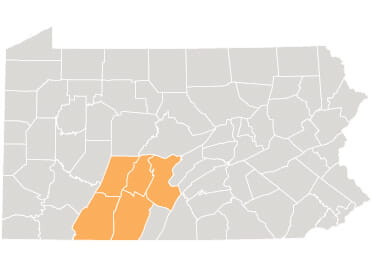


Cody, Lindsey, and their son Oliver live in Elkins, W.Va., with their dog Diesel and their cats, Fiona, Veronica, and Hook.
Cody was born with phenylketonuria (PKU), a genetic liver disease in which someone is born without the liver enzyme that breaks down phenylalanine, an amino acid found in many foods and drinks. For much of Cody’s childhood, he remembers:
“I had to drink a formula three times a day, every day. I had to avoid certain foods, restrict my diet. But I was used to it. I was used to the adversity.”
Around 6th grade, Cody was diagnosed with ulcerative colitis.
“When the ulcerative colitis started, it was kind of like, ‘Okay, is this related to the PKU?’”
Cody’s care team told him that his ulcerative colitis was not related to PKU.
“They said, ‘This could be something more serious. We’ve just got to monitor you and see how things go.’”
He later developed primary sclerosing cholangitis (PSC). PSC is a chronic condition in which the bile ducts become inflamed and eventually blocked. Bile duct blockages can lead to liver damage and eventually liver failure.
Cody believes that navigating these health conditions helped to prepare him for his liver transplant journey.
“Of course, being a kid, being in middle school, it was scary,” he says. “Before I got my medications right, there was a lot of pain associated with the ulcerative colitis and the PSC. But in a way, I think it’s made me a lot stronger as an adult now dealing with those kinds of things.”
When Cody was about 13 years old, his care team recommended that he receive a living-donor liver transplant for his PSC. Cody’s father’s primary care physician suggested that Cody seek a second opinion at UPMC Children’s Hospital of Pittsburgh. Cody and his dad travelled to Pittsburgh to meet with the UPMC Children’s Liver Transplant team.
After evaluating Cody, the UPMC Children’s team determined that his PSC was not advanced enough to require transplant and could still be medically managed.
“We were glad we did that,” Cody says.
He continued to work with his UPMC Children’s team to manage his PSC and ulcerative colitis before transferring to the UPMC Center for Liver Care and UPMC Digestive Health Care for his adult care, including yearly check-ups and scans.
By the time he graduated high school, Cody’s PKU was more controlled. He attended West Virginia University (WVU), started weightlifting, and played alto sax in the WVU Marching Band.
After college, Cody began working with his dad at his independent insurance agency.
“My dad and I have always been super close,” Cody says. “We’re buddies, always doing things together, traveling, going to WVU games. My dad’s still working, and he says, ‘I don’t want to retire because I get to work with my son every day.’”
In February 2024, Cody was in his mid-30s, and he and his wife Lindsey were looking forward to attending a Journey and Toto concert. But Cody’s annual MRI appointment in Pittsburgh clashed with the concert date. He decided to reschedule his MRI.
“My dad was mad at me,” Cody says. “He was like, ‘You’ve got to take care of yourself. You know how important it is to get that MRI every year.’ I said, ‘Dad, it’s fine. I got it rescheduled.’”
At Cody’s rescheduled MRI in July, they discovered a mass in his bile duct.
Follow-up testing revealed that the mass was a malignant tumor, and Cody had cancer.
“My dad and I were coming back from a business meeting in my truck when I got the phone call from UPMC confirming that the tumor was malignant. It was a punch in the gut, devastating. But we kind of assumed that would be the outcome and kind of prepped ourselves.”
In the same phone call, Cody learned that the UPMC Liver Transplant team would be reaching out to him to schedule a liver transplant evaluation. Living-donor liver transplant is a treatment for some liver cancers.
“There was really no down time,” Cody says. “Once they told us that we needed to start the transplant process, I was like, ‘Alright, let’s do this. Let’s get this taken care of and let’s move on with life.’ And I knew that I was in the best hands that I could possibly be in at UPMC. I was very thankful.”
After evaluating him, the UPMC Liver Transplant team determined that Cody was eligible for a liver transplant. The timing of Cody’s living-donor liver transplant depended on two things: Cody needed to find an eligible living-liver donor, and he needed to receive cancer treatment to control the growth of his tumor and prevent the cancer from spreading to other parts of his body.
Lindsey was the first person who signed up to be screened as a potential living donor for Cody.
Lindsey’s Journey to Become a Living-Liver Donor
 Lindsey is originally from Buckhannon, one town over from Elkins. A passionate dancer and dance instructor, Lindsey also enjoys exploring the outdoors with her family. She is a supportive learning instructor at Davis and Elkins College.
Even before Cody’s cancer diagnosis, Lindsey, Cody, and their family were going through a year of losses and challenges.
“It was like one thing right after the other. If it could go wrong, it did,” Lindsey says. “I think that’s why, at first, I was in complete denial when Cody told me that he might have this cancer diagnosis. I was just like, ‘No, you don’t. You’re going to be fine.’ But when we learned that it was cancer, and Cody would need a transplant, that’s when I went into fix-it mode. I said, ‘Okay, I’ll give you my liver. I’ll go and sign up.’”
When he found out that Lindsey had registered for a living donor evaluation, Cody’s immediate response was concern for Lindsey and their 3-year-old son, Oliver.
“I asked Lindsey, ‘If something happens to both of us, who’s going to take care of Oliver?’” Cody remembers. “Lindsey insisted on doing it. She was like, ‘I’m doing this for you. We’re married. We’re going to get through this together.’”
The UPMC Liver Transplant team evaluated Lindsey and determined that she was eligible to donate to Cody.
“After I knew that I could donate, I just felt relief,” Lindsey says. “There are people that sit on the national transplant waiting list for years. I was the first person who was tested for Cody. It was just a miracle, a blessing.”
Lindsey adds:
“I cannot give enough credit to everyone who works to help living donors and transplant patients at UPMC. I have to shout out my living donor coordinator Karen Emmett. She was always available, answering my questions, and keeping me in the know.”
One of the biggest challenges that Lindsey faced was taking time off work. At the time of her donation, Lindsey was teaching kindergarten. She felt like her leave from work was an inconvenience for her supervisors.
“It’s not like they ever told me, ‘Hey, we don’t want you to take off,’ or anything like that. I just had that feeling, like they were just disappointed, you know? That’s what’s hard, as a teacher. You’re expected to give 110%. But at that point in my life, my family comes first. Nothing was going to stop me from donating to my husband, and I needed time to be able to heal and take care of myself and my family. I felt no guilt about it.”
Cody and Lindsey’s Living-Donor Liver Transplant and Recovery
After completing six weeks of chemotherapy and radiation to control the growth of his cancer, Cody was ready for his living-donor liver transplant. Cody and Lindsey travelled to Pittsburgh, and their surgeries took place on January 9, 2025.
“You don’t realize how bad you felt until you actually have a healthy liver,” Cody says. “For me, it was immediate, even though I only had a portion of a liver. When I woke up, my dad asked me how I was feeling, and I said, ‘I’ve never felt better.’”
Cody even felt well enough to walk across the hospital to pick up a coffee for Lindsey and bring it to her hospital room.
Lindsey remembers that walking was one of the hardest parts of her in-hospital recovery.
“I could not believe how out of breath I would get. It was amazing. Cody would come in my room dancing, and I was just trying to walk with a walker.”
After a few days, Cody and Lindsey were discharged from the hospital and moved to a rental townhouse in Pittsburgh.
“UPMC, the nurses, everyone took care of us. Then, when we got to leave and come back to the rental house, we had our families there waiting for us,” Lindsey says. “We had people visiting and checking on us. It was love all around.”
Oliver, Cody’s parents, Lindsey’s parents, Cody’s sister, and Diesel stayed with Cody and Lindsey for part or all of their time in Pittsburgh. Family support extended beyond the rental home too. Cody’s uncle cared for the family’s cats while they were out of town, and Cody’s brother and sister-in-law travelled up to Pittsburgh to visit.
Supported by their loved ones, Cody and Lindsey spent several weeks resting, taking walks around the block, and playing with Oliver.
Lindsey wanted to keep Oliver’s routine as consistent as possible throughout the family’s stay in Pittsburgh.
“I didn’t want Oliver to miss anything or feel like he was put off to the side,” she says.
Cody’s sister Rachelle, Lindsey’s mom, and other family members and friends helped care for Oliver and drive him back and forth between Elkins and Pittsburgh so he could go to his usual activities, like gymnastics classes, daycare, and birthday parties.
After several follow-up appointments with the transplant team, Cody and Lindsey were approved to return to Elkins, W.Va. They arrived home on Valentine’s Day.
Cody and Lindsey’s family and community continued to support them.
“Our church put together a Food Train for us. I didn’t even have to cook for the first two weeks that we were back home,” Lindsey says.
An important part of Lindsey’s post-donation recovery was rest.
“I did not realize how fatigued I would be right after surgery. Of course, I knew I couldn’t lift much weight, couldn’t dance for a while, but it was amazing just how much your body needs to rest,” she says. “I just had to be okay with rest and letting my body heal. I took that time to enjoy being with Cody and our son, enjoy reading, enjoy TV.”
Life After Transplant
More than a year after his transplant, Cody enjoys new activities. He started subscribing to a strength training app and does seven workouts a week.
“Now, I’m in the best shape I’ve ever been in in my life,” Cody says. “I’m on a team, and they keep you motivated.”
He is also an assistant coach on Oliver’s Tee Ball team.
“I played baseball up until little league and then of course my health being what it was, I couldn’t continue to play. Now, I’m kind of living vicariously through Oliver,” Cody laughs. “I’m just thankful to be able to do these things and to be as healthy as I am now compared to what I was growing up.”
Cody’s diet has also changed. Because Cody received a portion of Lindsey’s liver, he now has the liver enzyme that breaks down phenylalanine. Cody is exploring foods and drinks that he either couldn’t eat or just didn’t like before his transplant.
“The funny thing is, I never liked coffee before. Now, I love coffee. There are foods that I would never have touched before my transplant. Now, I can eat just about anything.”
Through online support groups, Cody has been able to share his personal experience, offer support, and answer questions from transplant patients around the world.
“You don’t realize how many people need transplants until you’re a part of this community,” Cody says. “It’s just nice to be able to connect with people who are going through the same thing you’re going through.”
Cody wants other transplant patients to know:
“Everybody’s different. Everybody’s going to have a different experience. The important thing is getting educated about what your body can do and your treatment options and having an experienced team like UPMC by your side, to be your advocate, to help you get to where you want to be health-wise.”
Now, Cody and Lindsey are building their family home and enjoying concerts, movie dates, and family trips.
“We just find enjoyment in life. I enjoy every moment that I have,” Lindsey says.
“Going through this was very hard. But if I can get through this, I can get through most anything,” Lindsey says. “I want to be there for my community and give back to the people who supported us. I’m not afraid to do things, to make more positive changes in my life. Life is so unpredictable. You want to live the best of it.”
Cody and Lindsey’s treatment and results may not be representative of all similar cases.
