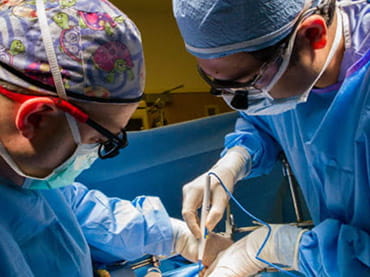
At UPMC, we are dedicated to providing lifesaving transplant options to all patients who will benefit. Established in 1981, UPMC Transplant Services has performed more than 20,000 organ transplant surgery procedures, including liver, kidney,pancreas, kidney/pancreas, intestinal (small bowel), liver/intestinal, heart, heart/lung, double-lung, single-lung, and multiple-organ transplants.
As a pioneer in the field of solid-organ transplantation, our program consistently accepts and treats some of the most difficult and complex cases. Our surgeons and specialists have leveraged this breadth of experience to develop advancements that have led to new and improved treatment modalities for our patients.
We're home to some of the world's foremost transplant experts, including:
- Medical specialists and surgeons.
- Nurses, clinical coordinators, and physicians who provide care and support before and after surgery.
- Researchers who move the field forward.
We take pride in keeping the lines of communication open with patients, families, care partners, and referring physicians regarding procedures, treatments, and follow-up care. Transplantation is a complex, serious procedure, and we maintain a personal, patient-focused approach that takes into consideration the stress and concerns many individuals experience.
Our programs include:
Our History
For more than 40 years, UPMC has been a leader in the field of organ transplantation.
From the early years when Dr. Thomas E. Starzl pioneered liver transplant surgery to discovering new ways to help patients accept their transplanted organs, we offer hope to thousands of people living with life-threatening organ failure.
Our advanced clinical research continues to create alternative life-giving transplant options for people around the world.
About the Thomas E. Starzl Transplantation Institute
The University of Pittsburgh’s Thomas E. Starzl Transplantation Institute is a leading research center dedicated to helping people from around the world with end-stage organ failure. The Thomas E. Starzl Transplantation Institute was established in 1985 as the Pittsburgh Transplantation Institute. It was renamed in 1996 in honor of Thomas E. Starzl, MD, PhD, whose foresight, perseverance, and commitment made him the modern-day father of solid organ transplantation. The Starzl Institute serves as the research arm of a close partnership with UPMC Transplant Services, which translates those scientific discoveries into world-class clinical care.
The mission of the Thomas E. Starzl Transplantation Institute is to improve the lives of patients with end-stage organ failure by continually improving the clinical, scientific, and social aspects of transplantation. The Starzl Transplantation Institute strongly emphasizes advancing basic science and clinically applied research, as well as teaching and training international specialists.
Our transplant team has a tradition of caring for some of the most medically compromised patients. Nevertheless, we have maintained patient and graft survival rates that meet national benchmarks.
A pioneering legacy
UPMC achieved world renown in transplantation with the arrival of Dr. Thomas E. Starzl in 1981. While the medical center already hosted a kidney transplant program (founded in 1964) and was the site of Pennsylvania’s first heart transplant (in 1968), Dr. Starzl brought two crucial elements to UPMC: his liver transplantation program and a new drug that would make transplantation an accepted treatment for many diseases that were otherwise considered incurable.
In his prior role at the University of Colorado, Dr. Starzl had performed the world’s first liver transplant and conducted much of the laboratory research to understand the barriers to successful transplantation. The most challenging obstacle was rejection — when an organ recipient’s immune system attacks a donor organ as it would any foreign invader, like bacteria or viruses. By the mid-1960s, Dr. Starzl and his colleagues at the University of Colorado and other pioneering programs had the surgical skills to perform liver transplants, but the antirejection medications available then weren’t effective enough, and their side effects — which included a changed appearance due to steroids and increased susceptibility to infections and certain cancers — could be severe.
Those barriers fell in 1979 when the new antirejection drug cyclosporine was introduced. Dr. Starzl was one of the first physicians to test the new drug in humans — and it marked a significant improvement, first increasing liver transplant success rates, then success with heart and other solid organ transplants. While building the world’s largest liver transplant program and later leading the Pittsburgh Transplantation Institute, Dr. Starzl continued his research on organ rejection. In 1989, Dr. Starzl and his team announced the results of a trial with the new antirejection drug FK506. It was another major step forward, proving to be 50 to 100 times more potent than cyclosporine with fewer side effects. The new drug enhanced survival rates for all transplant recipients and made it possible to transplant organs with especially high rejection rates, like the pancreas, lungs, and intestines.
In 1996, the Pittsburgh Transplantation Institute was renamed the Thomas E. Starzl Transplantation Institute. While Dr. Starzl retired from surgery and clinical service in 1991, he continued his research and served as Distinguished Service Professor of Surgery at the University of Pittsburgh School of Medicine.
In 1992, Dr. Starzl discovered that many organ recipients’ immune systems happily host cells from their donor organs, even decades after their operations. Theorizing that a less aggressive approach to antirejection treatment allows the organ recipient’s immune system to accept the donor organ, Dr. Starzl and his team were able to slowly and carefully wean transplant recipients to smaller doses of antirejection medications, maintaining their effectiveness while reducing side effects. Some patients thrive while taking antirejection medication as infrequently as once per week.
Our Innovations
Breakthrough antirejection therapies
We've been performing successful organ transplants for longer than most medical centers. That's because UPMC was one of the first centers to use the breakthrough drugs that keep patients' immune systems from rejecting their new organs.
Also, we have a long history of helping to develop new antirejection therapies that work well with fewer side effects — so organ recipients can enjoy better health with fewer restrictions.
Pioneering organ transplant procedures
UPMC experts have a distinguished history of pioneering and refining new transplant procedures, making it possible to provide a second chance at life for patients who otherwise would not have been candidates for transplantation.
Our physicians and researchers have accomplished many historical firsts, giving hope to patients across the country and around the globe.
Today, UPMC is home to one of the oldest and largest transplant programs in the country, and we are committed to advancing the field.
Our Future
Thanks to Dr. Starzl, one of transplantation’s greatest barriers — rejection — has been surmounted. But another barrier to transplantation remains — the chronic shortage of donor organs.
Each day, approximately 13 to 17 Americans die waiting for a donor organ.
If solid organs from animals could be made compatible with humans, no one would die due to a lack of available organs. More than a decade ago, UPMC surgeons transplanted baboon livers into two patients who only gained a few extra weeks of life, but bravely turned their terminal illnesses into medical progress. Recently, UPMC researchers have been developing genetically modified pigs with cells that are more compatible with the human immune system, making their organs less likely to be rejected.
UPMC Transplant Services Fast Facts
- UPMC is one of the most experienced transplant centers in the world.
- Since 1981, we have performed more than 20,000 organ transplants.
- Our researchers have led efforts to develop new immunosuppressive regimens that reduce rejection and enhance long-term outcomes.
Giving to the Thomas E. Starzl Transplantation Institute
Our medical specialists save lives and help people recover from life-limiting illnesses. They do this every day with innovative transplantation techniques and antirejection therapies — many of which were developed right here at UPMC with funding from people just like you.
You can become a part of this important work with a gift to support our extraordinary transplant research and patient care programs. Your generosity is the key to our success and will help save the lives of countless others.
Learn More About Donating