















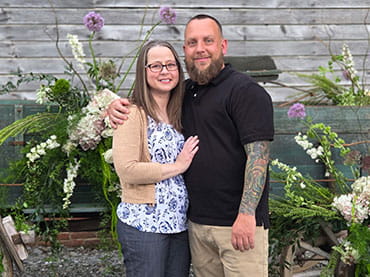
Melissa was born with cystic fibrosis, a genetic disorder that affects the lungs and other systems in the body.
Cystic fibrosis causes mucus to clog the airways and trap bacteria, which can lead to infections, inflammation, and respiratory failure. Melissa received her diagnosis at 2 years old and began seeing a doctor for regular follow-ups throughout childhood into adulthood.
In 2016, Melissa was attending appointments at a cystic fibrosis center close to home in Hershey, Pa., when they recommended that she be evaluated for a lung transplant evaluation at UPMC.
“I was feeling short of breath, but that was my normal,” Melissa says. “My condition was progressing, so my care team referred me to begin the evaluation process early.”
Early referral for lung transplant is key to improving treatment outcomes. Delaying the lung transplant evaluation allows more time for the disease to progress and your overall health to decline. It can also decrease your chances of being a suitable candidate for lung transplantation.
The team at the UPMC Lung Transplant Program recommended yearly follow-ups to monitor Melissa’s condition. In 2019, the UPMC team recommended a lung transplant as the next step in Melissa’s care.
“The evaluation process lasted a few days in Pittsburgh,” Melissa says. “They examined so many areas of my health through walking, blood, and heart tests to ensure that I was strong enough for transplant.
"We also had group-like classes to help prepare for the process and heard from a few transplant recipients who shared their stories.”
During the evaluation process, test results showed that Melissa was a candidate for lung transplant. She was placed on the national transplant waiting list.
After 10 months, Melissa finally got the call for her new lungs.
“It was the morning of my husband’s birthday, July 2, that I received the call,” Melissa says. “We went to the hospital as soon as we could, and I went right into surgery.”
Melissa had a smooth recovery. She spent 13 days in the hospital, closely monitored by the team at UPMC.
“I was very blessed and very lucky with recovery,” Melissa says. “I felt progressively better and didn’t have any major setbacks or issues.”
Following her lung transplant, Melissa and her husband stayed close to Pittsburgh. She continued to improve and challenge herself by walking on the track at the camp. After a few months, Melissa was cleared to go home and adjust to her new normal.
“I noticed immediately that my lung capacity was better,” Melissa says. “Going from 25% lung function before transplant to 117% now feels so different. I’m able to do things now that I previously wasn’t.
"We enjoy going camping in the summers. Before my transplant, I could hardly breathe in the hot and humid air. Now, being active, swimming, and spending time outdoors is a gift.”
Melissa continues to follow up with the team at UPMC. She is very grateful for each member of her care team who has been part of her journey. She's especially thankful for her husband and mother, who were her care partners throughout the process.
“My advice to others is to go into the process as fit as possible,” Melissa says. “This will help you heal and improve your outcome. Establishing a support system will also help you both emotionally and physically in your recovery.”
Melissa’s treatment and results may not be representative of all similar cases.
