















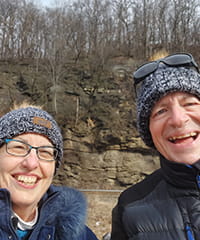
Lynn’s Diagnosis: Cirrhosis
At the time of his liver disease diagnosis, Lynn was a practicing attorney living in Hanover, Pa. with his wife and law practice partner Alison and their son John. Shortly after his 59th birthday, Lynn woke up in the middle of the night and began vomiting blood. He went to his local hospital and was diagnosed with esophageal varices, a complication of advanced liver disease. Lynn learned that he had cirrhosis, an advanced stage of liver disease.
Lynn and Alison were surprised to learn he had liver disease. There can be many different reasons for liver disease, including viral infections, metabolic conditions, and autoimmune disorders. Lynn’s care team believed alcohol use could be a factor in the development of his liver disease.
Lynn’s doctor recommended that he stop drinking alcohol and taking medications that could be toxic to his liver. Lynn followed these recommendations and for a while, he says “everything seemed to be going fine.”
About 10 years after his initial diagnosis, in June 2020, Lynn had surgery to remove his gallbladder. After the surgery, he says, “I started oozing this clear liquid out of the little surgical incisions. That was the first step of knowing something wasn’t right. Then, it was just a quick downhill slide.”
Lynn’s Journey to a Liver Transplant
In December 2020, Lynn was referred to UPMC for a consultation about his liver health and possible treatments. Alison joined him at the appointment. She remembers “When we talked about liver transplant as a treatment option, Lynn looked at me and said, ‘Not right now. That’s down the road.’” But after this consultation, Lynn’s disease continued to progress, and his need for a transplant became more urgent.
Lynn was evaluated for a liver transplant at UPMC and placed on the national transplant waiting list. But Lynn’s low Model for End-Stage Liver Disease (MELD) score meant that he was not likely to receive a liver from a deceased donor.
Alison says, “Lynn was always a little too healthy for the deceased donor list, but he wasn’t too healthy. I mean, it’s amazing how ill he was, and it still wasn’t bad enough.”
A living-donor liver transplant was a potential way for Lynn to receive a liver transplant sooner. But he needed to find a living donor.
As Lynn’s health worsened, he needed weekly outpatient appointments to drain fluid from his abdomen and receive an albumin infusion. Lynn says, “I would have a couple of good days when I could function a little bit, but then I would start to downhill slide until my next appointment.” Alison remembers, “He would either be in bed or on the couch. We couldn’t buy enough blankets for Lynn to wrap himself up and stay warm.”
John’s Journey to Become a Living Donor
Lynn and Alison’s son, John, was living with his parents as he completed his final year of college. John supported Alison and helped care for his father. Alison says, “John was such a saving grace for me. John and I, we were a team.”
Alison and John tried to help Lynn be as physically strong as possible for his potential liver transplant surgery. Alison says, “The doctors kept saying it was important for Lynn to be in good shape as possible for the surgery. The healthier he was going into it, the better the recovery. But Lynn just did not have the energy, and we couldn’t motivate him.”
John decided to go through the living donor evaluation process to determine if he was a match for Lynn. Lynn and Alison initially did not agree with this choice. Lynn says, “I did not want John to be my living donor. But eventually, I saw the position that he was stuck in. What was he going to do, watch me fade away or do what he could?”
After many conversations, Alison and Lynn supported John’s decision to go through the evaluation process, and Alison accompanied John to his living donor evaluation. “The team did such a wonderful job, and they were so informative and kind,” she says. John was eligible to be his father’s living donor, and he decided to go through with the surgery.
Lynn’s Living-Donor Liver Transplant
Lynn and John’s surgeries were scheduled for May 10, 2021. The week before the transplant surgery, Lynn and Alison attended John’s college graduation ceremony. Alison says, “It was very special that Lynn was able to go to the graduation.”
Lynn, Alison, and John traveled to UPMC Montefiore in Pittsburgh, Pa. for Lynn’s transplant. After Lynn and John were discharged from the hospital, the family stayed at Family House. John traveled back to Hanover to recover at home with friends, while Lynn and Alison remained in Pittsburgh for additional follow-up appointments.
During this time, Alison learned how to change Lynn’s bandages and helped him adjust to his new immunosuppressant medication schedule. Lynn says, “Alison helped make sure that I got my medicine at the right time, the right way, the right dose. She got me a pill organizer, and I still use it today.”
John’s Life after Living Donation
Alison says, “I just can’t say enough about our son, John. To this day, I don’t think he realizes how courageous and how lovely he is for being Lynn’s living donor.”
John is doing well after his donation. He has noticed some additional gastrointestinal issues, which he thinks may be related to the removal of his gallbladder. During the living-liver donation surgery, the living donor’s gallbladder is removed because it is located underneath the portion of the liver that will be removed.
Alison says, “I think that UPMC treated John beautifully. The nurses were so kind to him, and I really appreciated that.”
Lynn’s Life After Liver Transplant
Lynn and Alison are adapting to a new way of life after Lynn’s living-donor liver transplant. Alison says, “Going through the surgery is a very surreal experience. But the aftermath of the transplant is a lifetime of change, and the hardest thing to embrace when someone seems so healthy and back to their normal self.”
She continues, “There’s a lifetime commitment to the antirejection medication. Lynn has to be followed very closely by his medical team. He has regular blood work to keep tabs on things. Once a month, he’ll go through these chills for no real reason, but it just is. And they’re just little glitchy things, not horrid. And there are going to be additional changes in posttransplant life. Still, who cares? Because Lynn’s here. That’s the bottom line, he’s here.”
Lynn is grateful for the ups and downs of his posttransplant life. He says, “To this day, they haven’t been able to wipe the grin off my face. I just felt so much better after the surgery. Everything else since then, adjustments to my medications, getting an infection, it’s all just bumps in the road.”
Alison also reflects on the changes in Lynn posttransplant. She says, “As his disease progressed, Lynn seemed to become more tentative, which is never how he used to be. After his transplant, he was back to the person that I had married. I didn’t realize that the liver could have such a dramatic impact on somebody’s whole life, not just their liver health, but just their personality, everything. It was miraculous to me that he was back to who he had been.”
Lynn and Alison decided to make career changes after his transplant. “When I came out of surgery, I thought to myself, ‘You know what? I don’t want to fight with people anymore,’” Lynn says. They closed their law practice in Hanover and moved to Altoona, Pa.
Alison says, “We decided we wanted to try somewhere else, and part of posttransplant life, and getting older, is recognizing that life is short.” Now, Alison works for her church, while Lynn works for a community action center.
When they’re not working, Alison and Lynn enjoy exploring the parks and lakes in Altoona and taking trips to places like West Virginia. “We still think about risks for Lynn and we’re careful, but we like to do a lot,” Alison says.
Lynn says, “It’s amazing. I’m here because of the sacrifice that my son made for me and the great work that everybody did at UPMC.”
Lynn and John’s treatment and results may not be representative of all similar cases.
