















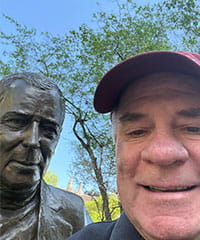
The night before Father’s Day 1981, painful stomach cramps were keeping 26-year-old Thomas Burke from sleeping.
After hours of tossing and turning, Thomas decided to go to his local emergency room in Rahway, N.J.
“I thought the hospital would be able to give me a muscle relaxant or something like that,” he recalls.
After initial blood testing, Thomas was diagnosed with anemia and admitted for an inpatient stay.
“I was shocked,” Thomas says. “I said, ‘No, I just need you to take care of this one little problem,’ and they said, ‘No, there’s something else going on.’”
Over the course of a two-week hospital stay, Thomas’s care team determined that he had a liver tumor and recommended surgery. Thomas’ father reached out to a hepatologist in nearby New York City for advice about which hospital Thomas should go to for liver surgery.
“The hepatologist said, ‘You need to go to Pittsburgh, and you need to see Dr. Thomas Starzl.’ Once he said that, that became the plan,” Thomas says.
Thomas' First Trip to UPMC
Thomas and his father traveled to Pittsburgh on Tuesday, July 7. His mother met them in Pittsburgh, where he was admitted to UPMC Presbyterian. Thomas’ surgeon was Thomas E. Starzl, MD, PhD, the liver transplant pioneer and founder of the UPMC Liver Transplant Program.
After some preliminary tests, Dr. Starzl and his team scheduled the surgery to remove Thomas’ liver tumor for Friday, July 10. “It didn’t seem like a big deal to me,” Thomas says.
But Thomas’ procedure took an unexpected turn.
“I went down for the procedure late in the afternoon and was back up in my room within an hour. And I knew that it couldn’t have been over that fast,” Thomas says.
Thomas learned that his tumor had enveloped more than half of his liver. The tumor could not be removed without also removing his liver.
“Dr. Starzl came walking into the room, and he tells me, ‘You know, I think I’ve got a better plan.’ And I was like, ‘Okay, what’s the better plan?’ And he said, ‘We’re going to do a liver transplant,’" Thomas says.
“Well, I had never heard of such a thing in my life. I’d heard about heart transplants, and I’d heard about kidney transplants, but I knew nothing about liver transplants. And since I had never heard of it, to me, therefore, it probably wasn’t a big deal. That was my way of thinking.”
The next afternoon, on Saturday, July 11, Thomas learned he had a possible liver match from a deceased donor.
“Around 5:30-5:40 p.m., Dr. Starzl comes strolling into the room to tell me he’s got a match and ask if I’ve got any questions,” Thomas remembers. “He didn’t seem to be the least bit hesitant; he acted like we were going to make a sandwich, you know? It came across as no big deal. So, if it’s no big deal to him, I thought that it certainly shouldn’t be a big deal to me.”
That night, Thomas underwent a liver transplant.
“I was in the operating room for about 18 hours,” he says. "They had to do several blood transfusions because, with my tumor, I was just bleeding a lot."
Thomas’ Liver Transplant Recovery
After his surgery, Thomas recovered in the hospital for about a month. He was one of the earliest adult liver transplant recipients, and there wasn’t a lot of data yet regarding adult liver transplant recipients’ long-term health outcomes. But Dr. Starzl’s expertise gave Thomas and his family hope.
“One time, as Dr. Starzl was leaving my hospital room, my mother followed him out the door to ask a question. She said, ‘I wanted to ask you about his long-term prognosis,’” Thomas recounts. “Dr. Starzl just stopped, and he turned around and walked back into my room with my mother. He said, ‘Ask the question again,’ because he wanted me to hear the answer. So my mother asked her question again, and Dr. Starzl answered, ‘Thomas’ long-term prognosis is fine. In fact, he’ll be bouncing his grandchildren on his knees.”
Thomas was discharged from the hospital on Aug. 13, 1981. He returned to New Jersey and enrolled in business school at Pace University in New York. He continued to develop his career, returning to Pittsburgh periodically for check-ups with Dr. Starzl and his transplant team.
Thomas Returns to Pittsburgh
In 1991, about 10 years after his liver transplant, a job change left Thomas at a crossroads. He decided to move to Pittsburgh.
“I had this feeling in the back of my mind, that if anything should happen to me, medically speaking, I’ll be in Pittsburgh, and they’ll know how to take care of me,” Thomas says. “It was almost my way of reassuring myself that everything would be fine. If I just move there, then I don’t have a thing to worry about. Whatever happens, they’ll take care of it.”
A few months after he relocated to Pittsburgh, Thomas met his future wife, Helene. Four years later, on March 12, 1995, Thomas and Helene married.
“In fact, our wedding anniversary is the day after Dr. Starzl’s birthday,” Thomas says. “We invited Dr. Starzl to the wedding, but he had a scheduling conflict and couldn’t attend. But he wrote me a note and said, ‘While I can’t be there physically, just imagine I’m over in a corner, and I’m smiling.’ So that’s what I did.”
Thomas’ Kidney Transplant
Helene and Thomas welcomed their son Brian in 1997 and briefly relocated to Washington, D.C., for work. Around this time, Thomas found out his kidney function was declining. The immunosuppressant medicine he took to protect his liver from rejection was damaging his kidneys.
He traveled to Pittsburgh for a nephrectomy surgery to remove one of his kidneys. Afterward, Thomas was living on dialysis, and his remaining kidney’s health was worsening. He needed a kidney transplant.
Thomas and Helene told their families and friends about Thomas’ need for a kidney donor, and their friend Lisa stepped up to be Thomas’ living-kidney donor.
Thomas, Helene, and Brian traveled to Pittsburgh for his living-donor kidney transplant. Thomas and Lisa underwent their surgeries at UPMC on June 14,1999. His son’s visits were the highlight of Thomas’ time in the hospital recovering from surgery.
“I could hear Brian when he got off the elevator,” Thomas remembers. “He was so gleeful that he was going to see his daddy, that you could hear the joy in his voice. I was equally happy to see him.”
Helene and Thomas honored Lisa when their daughter Lauren was born in 2002.
“Helene is Jewish, and in the Jewish faith, you name your children after people who have been special in your life,” Thomas says. “Helene wanted a name that started with the letter ‘L’ to honor Lisa, and we came up with the name Lauren.”
Connecting with Other Transplant Patients
Thomas has a long history of volunteering within the transplant community. Through the decades since his liver transplant, he has met hundreds of transplant patients, listened to their stories, and shared his experiences.
Balancing hope and acceptance continues to be a feature of Thomas’ transplant journey.
“I’ve told people for the last 45 years that there’s so much the doctors can do for you, and then it’s kind of up to you,” Thomas says. “Patients have trials and tribulations along the way. Try not to worry about what you can’t control and take care of yourself with the basics. Wash your hands, stay away from people who may be ill, the basics.”
Throughout his health complications, Thomas’ personal stance has been: "Accept it for what it is and do what they tell me to do. Make it as good as possible. That’s pretty much what I do.”
Thomas emphasizes the importance of communicating and advocating for yourself as a transplant patient.
“Every single patient has different worries or questions – make sure you ask your medical team these questions. They won’t know your questions if you don’t ask,” he says.
Thomas’ Experience as a Liver Transplant Care Partner
Decades after his own liver transplant, Thomas experienced the transplant journey as a caregiver.
His wife Helene had developed metabolic dysfunction-associated steatotic liver disease, which worsened over time.
“The doctors told us that the ultimate ‘fix’ for Helene’s predicament was a liver transplant," Thomas recalls. "Medication could help prolong her life, but she would never get ‘well’ until she could get a liver transplant.”
In July 2023 Helene was evaluated and approved for a liver transplant.
A living-donor liver transplant was a potential way for Helene to receive a transplant sooner than if she waited for a liver from a deceased donor. Helene and Thomas reached out to their community to share Helene’s need for a liver transplant and search for a living donor. They knew that it was important to share Helene’s story with their community.
“We didn’t really have any hesitancy because we didn’t ask anybody, ‘Oh, would you be willing to do this?’” Thomas says. “We just talked about the two possible solutions. You can either get a liver transplant from a deceased donor or from a living donor. One of the good things about a living donor transplant is that the living donor is healthy and goes through a whole evaluation process to determine if they’re a suitable donor candidate.”
Helene’s family friend Ilana Lasday chose to become her living-liver donor.
“Ilana’s parents and Helene’s parents were best friends virtually their entire lives. Helene’s known Ilana since the day Ilana was born,” Thomas says.
Helene and Ilana’s surgeries took place on Jan. 10, 2025.
“To my knowledge, we are the first liver transplant recipient couple in the U.S,” Thomas adds.
Helene’s Liver Transplant Recovery
More than a year after her liver transplant, Helene is recovering.
“She still has issues with her short-term memory, dating back to her hepatic encephalopathy. I wish her memory would get better faster, but that’s more my impatience than anything else,” he explains. “I am 71 years old, I’m not always going to be around, so I want to make sure Helene can take care of herself.”
“Being a caregiver is not an easy thing,” Thomas says. “From experience, I know that you’re worried and concerned about your loved one. But it’s important to show your loved one that you, their caregiver, their support person, are still hopeful. Part of the whole process of undergoing a transplant and getting well is your own internal sense of ‘I want to get better. This is a struggle, but I’m going to get better.’ Seeing your loved ones in good spirits can help with that.”
Thomas sometimes worries that he won’t be able to recognize Helene’s needs. He has reached out to his transplant coordinator for support and guidance.
“I look to my coordinator,” Thomas says. “Tell me what I need to do, the things that I might forget or that I might have forgotten.”
As Helene has recovered over the past year, she and Thomas have traveled to see relatives and to attend weddings. This year, they are mulling over a longer trip to Seattle, Wash.
“We’re thinking of taking the Amtrak there,” Thomas says.
When he’s not traveling with Helene, Thomas enjoys walking his dog and watching University of Pittsburgh and Indiana University football and basketball games.
Thomas’ Friendship with Dr. Starzl
Thomas developed a decades-long friendship with Dr. Starzl.
“I tell everyone that the luckiest thing that ever happened to me was meeting Dr. Starzl. I think about him every day,” Thomas says. “Yes, he did save my life, but he was the most interesting person to talk to. And he was interested in everything. I always thought that one of his finest traits was he was interested in the people he was talking with. He wanted to know your thoughts, your feelings, your perspective.”
Thomas and Helene’s treatment and results may not be representative of all similar cases.
