















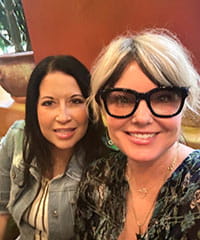
Vicki Smith’s liver transplant journey began in the early 2000s when she was diagnosed with polycystic kidney disease (PKD). PKD is a genetic condition in which cysts form in the kidney.
Born and raised in Pittsburgh, where she lives with her husband, daughter, and dog, Vicki is a registered nurse. After graduation from UPMC Shadyside School of Nursing, her first job was at the UPMC Presbyterian abdominal transplant intensive care unit (TICU). There, she cared for people who'd either just received a transplant or were having post-transplant complications.
Later, Vicki became an insurance case manager, helping people find health care services and navigate the transplant process.
Vicki’s Diagnosis: Polycystic Liver Disease
People with PKD sometimes also develop polycystic liver disease (PLD), meaning that cysts form in their liver, too.
Years after her initial PKD diagnosis, large, painful, non-cancerous cysts developed on Vicki’s liver. The cysts were laparoscopically removed, but a year later, more cysts developed.
“They couldn’t even count them anymore,” she remembers.
Vicki’s liver also began to grow larger as the cysts increased in number. Her care team at the UPMC Center for Liver Care grew concerned that removing these cysts could damage her liver function. Together, they discussed treatment options, including liver transplantation.
While the cysts on her liver were painful, Vicki was hesitant to consider a transplant at that point. “I didn’t really want to move forward with the transplant at the time because I wasn’t having major symptoms,” she says.
But over time, the condition increasingly affected her daily life. Vicki eventually left bedside nursing, in part because the size of her liver made it too difficult to lift and rotate patients.
“At one point, the liver was so large, it pushed into the bottom half of the right lobe of my lung,” Vicki says. “I started to get shortness of breath. It was interfering with my normal activities during the day — I couldn’t run; I couldn’t do things.”
When Vicki’s liver health began to worsen in 2023, daily activities became even more painful.
“It started getting to the point where it was miserable just sitting at my desk because I could only sit in the same position for so long,” Vicki says. "I was having a hard time sleeping. I eventually had to start taking pain medication, which I hated because I didn’t like the way it made me feel. But it was really the only way I could get through a workday.”
In the autumn of 2024, Vicki says, “I finally decided, ‘Alright, it’s time.’” She met with her liver care team and started the evaluation process to determine if she was eligible for a liver transplant.
She learned that a living-donor liver transplant could be a faster option than a deceased-donor liver transplant. But she would need to find a living donor.
The next day, Vicki told her coworkers she'd be taking time off work for the liver transplant evaluation process. One coworker, Lindy LaValley, immediately asked for the link to sign up for screening to see if she could be a living donor for Vicki.
“I thought, ‘OK, she’s just trying to be nice,’” says Vicki. "Less than 10 minutes later, Lindy said, ‘Okay, I’ve signed up. Let’s get this going.’
"I said, ‘Are you serious?’ From that moment on, she was just dead-set that she was going to be my donor.”
Lindy’s Journey to Being a Living Donor
Pittsburgh-native Lindy LaValley served in the U.S. Army as a combat medic for four years before leaving the military and enrolling in nursing school. She built a career in pediatric and adolescent behavioral health and later moved into insurance case management. Working at the same organization as Vicki, she became director of clinical operations, overseeing a case management team.
Even before talking to Vicki, Lindy had already decided that she wanted to become a living donor. In fact, three weeks before their conversation, she'd reached out to UPMC to learn about the process of becoming a living donor.
“I don’t have any children," Lindy says. "Living donation was, to me, my way of giving life, and I really wanted to do this."
When she learned about Vicki's need for a liver transplant, Lindy says, “it was like we were meant to have that conversation.” A few days later, her living donor evaluation was underway.
“The staff was amazing,” Lindy says. “I had their support every single step of the way, including the to-do items that I needed to complete prior to all my testing.”
Shortly after completing her evaluation, Lindy learned that she was eligible to be Vicki’s living donor.
Lindy's family was both supportive of and nervous about her decision. “My husband had feelings of concern and fear and doubt, which is completely understandable," she says. "It is a big commitment. But through it all, he and my family absolutely held my hand, and they stayed as positive as they could."
During several open, honest conversations with her loved ones, Lindy shared the reasons why becoming a living donor was so important to her. She also gave them educational resources that addressed their concerns.
“The conversations were really around, ‘What if something happens during surgery?’” Lindy says. “What I found to be very helpful was sharing all of the resources that I received through my evaluation and through meeting with staff," she says. "My family knowing that I had so many people supporting me at UPMC was another positive.”
Vicki and Lindy’s Living-Donor Liver Transplant
 On the Saturday before their surgeries, Vicki, Lindy, and their families met for dinner.
“We talked the entire time," Vicki says. "It was like we had all been friends for years, and now we’re like part of each other’s family."
Vicki’s living-donor liver transplant and Lindy’s donation surgery took place on Tuesday, February 11, 2025.
Posttransplant recovery
When Vicki woke up from her transplant, Lindy was on her mind.
“The first thing I remember asking when I came out of surgery was, ‘Is Lindy okay?’” Vicki remembers. “I was so worried that something was going to happen to her after she went and did this beyond amazing thing. As we recovered, my coping mechanism for this worry was just to talk to her and let her know that I was thinking about her and sending her all the love and support.”
During the first few days after her transplant, Vicki felt at ease knowing that her former coworkers in the TICU were caring for her.
“I felt super safe because I already knew that they were great nurses," she says. "I could not have asked for better care. They were completely fantastic.”
Vicki’s family was also by her side, encouraging her as she recovered. “They were all amazing,” she says.
“My daughter was having her college midterms, but she said, ‘I’ll bring my homework; I’ll sit with you,’" Vicki says. "She made me get up and walk the hallways when I didn’t feel like it.”
Vicki’s close-knit bond with her sister, her main care partner, made her at-home recovery easier.
“I know everybody’s bodies are going to respond differently," Vicki says. "For me, I was so swollen and deconditioned, I needed help making sure I didn’t fall walking from one room to the next."
“Everything my sister saw, we have no secrets anymore," she adds. "She had to be there through those uncomfortable showers, trying to hold my surgical drains. Really make sure that your caregiver is somebody that you can be comfortable with, and they’re OK in awkward situations.”
Throughout her recovery, Vicki reminded herself that she was on her own timetable.
She wants other transplant recipients who are recovering posttransplant to know, “It’s okay, it’s going to take time. Everybody’s different; everybody goes at their own pace. Don’t compare your journey to anybody else’s.”
After her surgery, Lindy also immediately thought of Vicki. “She was the first thing that crossed my mind. I wanted to know if she was okay,” Lindy says.
“My first lap, my very first lap out of my room, I walked past Vicki’s room, and I saw her," Lindy says. "She looked like a completely different person."
"I got so emotional," she adds. "I literally cried in the hallway, I was so happy to see her, to see that she was OK.”
During her recovery in the hospital, Lindy developed lidocaine toxicity, a reaction to one of her post-surgery pain medicines. She started experiencing symptoms like sharp pain in her chest and jaw, numbness and tingling in her left arm, body tremors, and double vision. Lindy’s care team acted quickly to address her lidocaine toxicity and adjust her pain medicine regimen.
"The whole team was there. They were on the ball, they knew exactly what was going on, what I was feeling, and why. The response of the team and how quickly they took care of me really helped me feel a lot more at ease in an otherwise somewhat scary situation,” Lindy says.
At home, Lindy’s care partners, her husband, twin sister, and nephew, were key to her recovery as a living-liver donor.
“It takes a lot for your body to regenerate a liver — the level of exhaustion and fatigue was like nothing I've ever felt,” she says. “But every single day, something would get better. It was six months of it getting gradually better and better.”
Lindy found safe, creative ways to become more active as her energy levels increased. “I sorted through all of my records, my albums, my vinyls," she says. "My husband and I painted self-portraits of each other one night, just for fun.”
Lindy continued to remind herself, “‘I had major surgery, and it’s going to take a while. I’m doing a great job. I’m healthy, I’m getting through it.’”
Her community's support and her connection with Vicki also helped Lindy through her recovery.
“Vicki and I texted almost every day about everything that we were going through together in our healing journeys," Lindy says. "We would talk about our periods and the constipation and the side effects and the exhaustion. Vicki and I staying in such close contact was awesome.”
Life after Living-Donor Liver Transplant
As Vicki regained her strength through the spring and summer after her transplant, she was able to participate in more activities, like going to a Post Malone concert with her daughter and then a group trip to celebrate her daughter's 21st birthday. She also returned to work.
Vicki treasures the small ways in which her life has changed posttransplant. Before her transplant, “I was always kind of breathless," she says. "I don’t think I’ve laid on my stomach in like 13 or 14 years, just because it was so uncomfortable. Now it’s like, ‘Oh my god, I can do all of that stuff,’" Vicki says. "Just all of the little things you don’t even think about.”
Vicki works with her UPMC transplant team to monitor her posttransplant health and attends regular follow-up appointments. “I love going into the outpatient transplant clinic to say hi to everybody and catch up,” she says. “They’re beyond amazing.”
More than a year after her donation, Lindy feels "absolutely amazing."
"I almost feel like healthier, more rejuvenated in a way than prior to the surgery,” she says.
For Lindy, the first year after her living donation has been a time of change. She is now going through perimenopause and was recently laid off from her job. But through these life changes, Lindy’s experience of being a living donor has reinforced her belief in her own resilience.
“I can get through anything," she says. "Everything is going to be OK."
Lindy's living donation experience has also affirmed her belief in the power of community. “It just reinforced the importance of showing up for people, treating people like you want to be treated, all of those things for me,” she says. “And when things are hard, it’s OK to lean on people.”
Vicki and Lindy’s Path to Living-Donor Transplant Advocacy
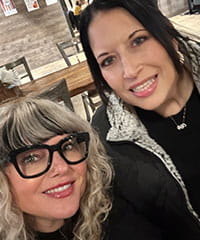
Post-transplant, “Lindy and I, we are like part of each other forever,” Vicki says.
The two are now exploring how they can advocate for the living donor and transplant community together.
“Lindy and I try to do anything we can to help educate other people," Vicki says. "We want to talk to people who are going through the same situation that we went through."
Lindy wants to share her experience of the challenges and joys of being a living donor.
“Living donation can be scary for the donor, for the family,” she says. “But it really is an experience that you can get through. It’s manageable, it’s a positive, beautiful thing. And hey, you get to save a life while you’re at it. "It’s pretty amazing."
Vicki and Lindy’s treatment and results may not be representative of all similar cases.
