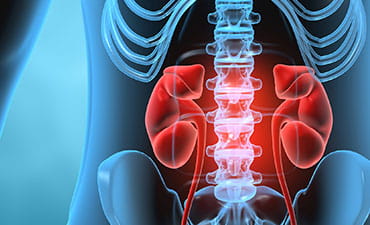
At UPMC, our goal is to improve the lives of people who have renal (kidney) disease. As one of the nation's most active and experienced transplant programs that performs more than 200 adult kidney transplants each year, we have vast experience in kidney and combined kidney-pancreas transplants. As a result, we take on some of the most challenging cases and deliver outstanding outcomes.
The team brings decades of experience in both deceased donor and living donor transplants and offers donor exchange options, which provide patients with a shorter wait for an organ to become available. Our world-class expertise also extends across the UPMC system, with our expert surgeons performing kidney transplants at UPMC Montefiore in Pittsburgh, Pa., UPMC Hamot in Erie, Pa., and UPMC Harrisburg in Harrisburg, Pa. Each location combines specialized kidney care with comprehensive resources to deliver life-changing treatment options for patients.
What Is A Kidney Transplant?
During a kidney transplant, a surgeon removes a kidney from a deceased donor or a healthy adult known as a living donor and transplants it into a patient with end-stage kidney disease. Living donor kidney transplant procedures are possible because, although you have two kidneys, you can live a healthy life with only one working kidney.
Who’s Eligible for A Kidney Transplant?
You may be eligible for a kidney transplant if you have end-stage kidney disease. The UPMC transplant team will perform a pre-transplant evaluation to determine if a kidney transplant is right for you.
What Services Do We Offer?
We offer many types of transplants. including:
Kidney transplants
The options for kidney transplant include deceased donor and living-donor kidney transplants. Each has unique risks and benefits, which we will discuss in detail with you during your transplant evaluation visit.
Deceased donor kidney transplant
- Kidneys come from closely screened, deceased donors to ensure the kidney is suitable for transplant.
- Because people undergoing a deceased-donor transplant are on the national transplant waiting list for a kidney donor, it's unknown when your transplant will occur.
Living donor kidney transplant
- A healthy person — often a blood relative, close friend, or stranger (an altruistic donor) — provides a kidney. In some cases, donors who meet eligibility requirements can take part in a kidney exchange, also known as paired donation, which involves “swapping” kidneys between two or more incompatible donor-recipient pairs.
- We can schedule a living-donor transplant surgery to allow time for both the patient and donor to plan and prepare.
Minimally invasive robotic surgery for living kidney donors
- UPMC surgeons have access to advanced technologies and robotic systems to assist with transplant surgery when appropriate. As a result, we use exclusively minimally invasive robotic techniques to perform living donor kidney surgeries. Using a robotic system instead of traditional surgical techniques or open surgery allows surgeons to perform minimally invasive living donor surgical procedures with greater precision, less tissue damage, and better visualization — providing easier access to hard-to-reach areas.
- In 2024, UPMC kidney transplant surgeons performed a robotic nephrectomy on a living donor using the multiport robotic surgery system, da Vinci Xi® by Intuitive. UPMC Harrisburg was the first program in central Pennsylvania to use this robotic system. In some instances, our adult kidney programs perform a robotic nephrectomy on living donors.
Kidney-pancreas transplant
This type of transplant helps people with type 1 and type 2 diabetes whose kidneys are failing — or have failed — and who need both a new kidney and pancreas. Surgeons transplant both the kidney and pancreas during one surgery. These surgeries are performed at UPMC Montefiore in Pittsburgh.
Pancreas-after-kidney transplant
People who remain diabetic following a kidney transplant may receive a pancreas-after-kidney transplant to prevent any future damage to the new kidney. Surgeons transplant the pancreas following a successful kidney transplant. These surgeries are performed at UPMC Montefiore in Pittsburgh.
What Can I Expect?
Located in Pittsburgh, Erie, and Harrisburg, our program accepts self-referrals and physician referrals.
Multiple listings for kidney transplant
Multiple listings happen when a kidney transplant candidate registers at two or more transplant hospitals. UPMC accepts patients who are multiple-listed.
Within the UPMC network, kidney transplant candidates may choose to list at UPMC Montefiore, UPMC Hamot, or UPMC Harrisburg.
What happens after your doctor refers you to the UPMC Kidney Transplant Program?
Scheduling your kidney transplant evaluation
Our team will schedule an appointment for your transplant evaluation. Before your appointment, our experts will review your medical history and prior testing to determine whether you may be a kidney transplant candidate.
We have clinics throughout Pennsylvania where you can find out if a kidney transplant is an option. Find a location.
At your kidney transplant evaluation
At your kidney transplant evaluation, you will meet with our medical and surgical transplant teams to discuss your disease and the short- and long-term details of transplantation. Your care team may also order tests and perform exams to learn more about your condition.
After your kidney transplant evaluation
A multidisciplinary group of experts will review your case and decide if a kidney transplant is your best option. We'll let you know our decision within several weeks of your evaluation.
If you qualify for a kidney transplant at one of our clinics, we will arrange your surgery at one of our three UPMC transplant centers.
Your kidney transplant team
Your kidney transplant team may include:
- Living donor coordinators — Guide living donors through all phases of the donation process. The living donor coordinator is your resource for all questions and concerns about living donation.
- Nephrologists (kidney specialists) — Diagnose, treat, and manage kidney conditions and kidney failure.
- Nurse practitioners — Work closely with doctors, nurses, and staff to extend the care provided by doctors. Nurse practitioners participate in the care of transplant candidates, kidney transplant recipients, and living kidney donors.
- Pharmacists — Transplant pharmacists assist with medication management and medication education before and after transplant.
- Research transplant coordinators — Transplant nurses who coordinate and oversee patients who participate in research protocols for studies and clinical trials.
- Surgeons — Perform transplant surgeries.
- Transplant coordinators — Registered nurses who provide education and guidance before and after your transplant.
- Transplant financial coordinators — Review your insurance coverage for transplant and post-transplant medications. They may also be able to recommend additional coverage to reduce your out-of-pocket expenses after transplant.
- Transplant social workers — Help you review your social, financial, and support systems to make sure that your transplant can be a successful experience. They will also be available after transplant to help you get the medicines you need and address other social concerns you may have.
Why Choose UPMC for Kidney Transplant?
When you choose UPMC for kidney transplant care, you will receive:
- Access to experienced, board-certified specialists — Since 1988, our surgeons have performed more than 5,400 deceased-donor kidney transplants and 2,600 living-donor kidney transplants.
- Expert care for complex cases — As one of the nation's most active and experienced transplant programs, we have extensive experience in kidney and combined kidney-pancreas transplants, allowing us to take on some of the most complex cases.
- Personalized kidney transplant care — From thorough evaluation to world-class treatment, we provide a patient-centered approach to care throughout the entire transplant process. Your dedicated transplant team will guide and support you every step of the way.