What Is Living-Donor Liver Transplant?
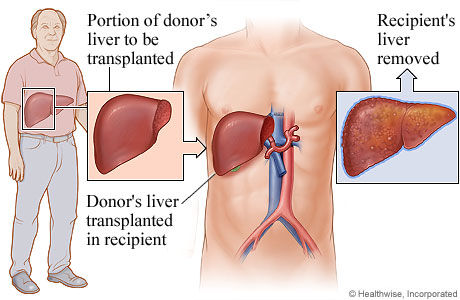
During living-donor liver transplant surgery, a living person has a piece of their healthy liver removed and transplanted into another person to replace their unhealthy liver. These transplants are possible because of the liver’s unique ability to regenerate, or regrow.
Living-donor transplants allow patients with end-stage liver disease to get lifesaving transplants sooner than waiting for deceased-donor livers to become available.
This saves the life of not only the recipient of the living-donor liver transplant, but also a second candidate waiting on the liver transplant waiting list. The candidate on the list can now receive a deceased-donor organ that would not have been available to them without the living-donor liver transplant occurring.
Living-donor liver transplant
For a living-donor liver transplant, a healthy person donates a portion of their liver to the transplant recipient. The recipient's liver is removed and replaced with this part of the donor's liver. The recipient's and donor's surgeries are carried out at the same time in different operating rooms.
Both the portion of the liver remaining in the donor and the portion donated will grow back to normal size.
© 2016-2025 Healthwise, Incorporated. This information does not replace the advice of a doctor.
What are the types of living liver donation?
There are three types of living liver donation, including:
- Directed liver donation — A living donor chooses a recipient for part of their liver. Often, donations are made by family members or close friends.
- Nondirected liver donation — Also known as an altruistic donation, a living donor gives part of their liver to someone they don’t know. The donation may be anonymous.
- Paired liver donation — Also known as a “swap,” this occurs when two or more liver recipients trade willing donors. Paired donations occur when a living liver donor and their intended recipient are not a match.
What Conditions Do We Treat?
We provide comprehensive transplant care — from your pretransplant exam to living donor and transplant surgery — for recipients with end-stage liver disease and their living liver donors.
We treat end-stage liver disease caused by conditions including:
Who’s Eligible for Living-Donor Liver Transplant?
Living donors can be family members, friends, or even strangers who are willing to donate a liver. A patient on the transplant list and their potential living donor don’t even need to have the same blood type.
To be a living donor, you need to be physically and mentally healthy, with no history of illnesses involving any major organs, as this could complicate surgery.
Who is eligible to be a living liver donor?
To become a living donor, you must:
- Be between the ages of 18 and 60.
- Be in good health. Conditions such as uncontrolled high blood pressure, cancer, HIV, hepatitis, or other disorders could prevent liver donation.
- Meet all other living liver donor eligibility requirements.
The transplant team at UPMC evaluates potential liver donors to ensure that you're a good fit for organ donation. We ask that donors have an unselfish desire when wanting to help someone in need of a life-saving liver transplant.
Do I need to be a relative of the person who receives my liver?
Although many people wish to donate their liver to a family member, you can also donate it to an unrelated person.
In some liver transplant cases — depending on a blood type match and other requirements — donors can take part in a liver exchange or “swap,” also known as a paired donation. This means two or more pairs of related donors and recipients donate to each other.
What are the risks of living-donor liver surgery?
Research has shown that there is little long-term risk or effect on a living liver donor. Rarely, living liver donors may experience liver failure.
But, as with any major surgery, liver donation surgery can include complications such as:
- Bleeding.
- Infection.
- Blood clots.
Death is very rare but has occurred in a few cases.
Our living-donor liver transplant team will discuss all risks in detail to make sure liver donation is the right choice for you.
Who is eligible to receive a living-donor liver?
Anyone who needs a liver transplant is eligible to receive a living donor liver. However, the donated liver must be a suitable match for the recipient to reduce the risk of complications after transplantation.
What Living-Donor Liver Transplant Services Do We Offer?
Living-donor liver transplant services include:
Living-donor liver transplant
During a living-donor liver transplant, a surgeon removes a portion of a healthy adult’s liver and transplants it into a patient with end-stage liver disease. The liver has the unique ability to regenerate, or regrow, in just a few months, leaving both the living donor and the recipient with a fully functioning liver.
Our philosophy is that living donation should be discussed with every patient, as it can reduce time on the waiting list from years to just months while also improving outcomes.
UPMC provides living-donor liver transplant services to all who will benefit, including patients with complex conditions, such as:
- Acute liver failure.
- Alcohol-associated liver disease.
- Cholangiocarcinoma.
- Low MELD score.
Supportive services for living-donor liver transplant
Living donor mentors
UPMC offers the opportunity for potential living liver donors to speak with someone who has already been a living donor. If you’d like to connect with a mentor who can share their personal experience with you, please reach out to your living donation liaison.
Living Donor Champion program
For patients with end-stage liver disease who are considering a living-donor liver transplant as an option, the living-donor transplant team will help you through the entire process, including finding a donor.
We offer a variety of resources to assist you in your search for a living donor through our Living Donor Champion Program.
The program is designed to help you:
- Identify resources and strategies to successfully find a living donor.
- Learn more about who can be a living donor.
- Speak to family and friends about living donation.
Second opinions at UPMC
We routinely provide liver transplant care to those with complex cases and discuss the benefits of a living-donor liver transplant with people who may qualify. If you’ve been turned down for a liver transplant at another center, or if you’d like a second opinion about your liver transplant options, our experts are available.
To learn more about receiving a second opinion at UPMC, call 412-647-5800.
What Can I Expect?
Living-donor liver transplants help save the lives of people with end-stage liver disease by reducing their time or eliminating the need to be placed on the transplant waiting list. Living-donor liver recipients often have improved outcomes and a quicker recovery.
Living donors are given the rare chance to give someone the opportunity to return to health and happiness.
During the process, living liver donors can expect:
Pre-liver-donation evaluation
Before scheduling living-donor liver surgery, you will undergo a thorough pre-liver-donation evaluation.
The evaluation of a living liver donor involves several steps. Potential donors will meet with all members of the living donor team during this process.
The team includes:
- Dietitians.
- Independent living donor advocate.
- Nurse coordinators.
- Pharmacists.
- Physicians.
- Social workers.
- Surgeons.
All potential donors are screened carefully to make sure they are healthy and able to donate.
This will ensure that:
- You can tolerate the surgical removal of part of your liver and remain healthy after, with no increased health risks.
- The transplant recipient will benefit from your donor liver.
Independent living donor advocate (ILDA)
The ILDA is a social worker who has received advanced education to be an independent and specialized advocate for living donors.
The ILDA's role is to ensure that living donors understand the entire living donor process and are freely choosing to be living donors without external pressure.
As a potential living donor, any questions or concerns you may have about the care you receive from the transplant team may be directed to the ILDA.
How should I prepare for living-donor liver surgery?
Your living-donor liver transplant nurse coordinator will provide details on how to prepare for your surgery.
We ask all organ donors to follow basic health measures. This will help ensure your surgery proceeds smoothly and lower the recipient's risk of rejecting your liver.
Health measures include:
- Stop smoking — If you're a light smoker, please stop smoking at least one month before your liver donation surgery. People who smoke heavily do not make ideal organ donors since smoking increases surgical risks.
- Avoid alcohol and drugs — Before living-donor liver surgery, you must avoid using alcohol and drugs. We also ask that you inform your living-donor transplant nurse coordinator of any medications you take.
- Stop oral (by mouth) contraceptives — Donors should stop oral contraceptives around eight weeks before liver donation to prevent blood clots after surgery. We strongly advise you to use other forms of birth control during this time.
Who pays for liver donation surgery?
The recipient’s insurance and UPMC will cover the costs of the evaluation and donor surgery. The donor will not be responsible for any part of the transplant assessment or procedure and will meet with a financial coordinator during the evaluation to ask questions about the process.
Living-donor liver transplant surgery
On the day of your living-donor liver transplant surgery, we will admit you to the hospital.
You will meet with the liver transplant surgeon and anesthesiologist who will:
- Review the surgery with you.
- Have you sign consent forms.
- Answer any last-minute questions.
After the paperwork, you will proceed to the operating room.
Living-donor liver transplant surgery can take three to five hours.
Your loved ones can wait in the waiting area, where staff will provide frequent updates. After the surgery is complete, your liver transplant surgeon will also meet with your family members.
After living-donor liver transplant
Following living-donor liver surgery, you will move to a unit to make sure you do not need further treatment. From there, you will transfer to a transplant recovery floor where you could stay for a few days before going home.
Will I need to take any medication after donating my liver?
Medications to control your pain and some other routine post-operative medications may be needed during your hospital stay, but it is unlikely you will need medication after you leave the hospital.
How soon will I be able to return to work after living-donor liver surgery?
It takes up to two months for most living liver donors to recover fully, depending on their jobs.
Thinking of Becoming a Living Liver Donor?
For those thinking about donating a portion of their liver, UPMC's living-donor liver transplant team works together to make the process run smoothly.
We recognize how hard the decision to donate an organ can be. Our liver transplant team will serve as your support system every step of the way.
Why Choose UPMC for Living-Donor Liver Transplant Care?
When you choose UPMC for living-donor liver transplant care, you will receive:
- Access to experienced, board-certified specialists — UPMC is one of the oldest and largest liver transplant programs in the country. Since the program's inception in 1981, more than 6,000 adults have received liver transplants, and more than 1,000 adults and children have received living-donor liver transplants.
- Expert care for complex cases — As one of the nation's most active and experienced transplant programs, we have vast experience in living-donor transplants that allows us to take on some of the most complex cases.
- Personalized living-donor care — From thorough evaluation to world-class treatment, we provide a patient-centered approach to care throughout the entire transplant process. Your dedicated transplant team will guide and support you each step of the way.