If you’re tired of wearing eyeglasses or contact lenses, you may want to consider LASIK eye surgery.
LASIK treatment can correct vision problems like nearsightedness, farsightedness, and astigmatism in some people. It’s a common procedure that uses a strong beam of light to permanently reshape the cornea.
LASIK can reduce your need for eyeglasses or contact lenses, or eliminate the need entirely. The eye care team at UPMC can tell you if LASIK is right for you.
What Is LASIK?
Laser-assisted in situ keratomileusis (LASIK) is a surgical procedure that treats vision problems caused by refractive errors.
Refractive errors happen when your eyes don’t refract — or bend — light properly. These errors cause vision problems like nearsightedness and farsightedness.
LASIK uses a laser (beam of light) to reshape your cornea and improve your vision. It’s an outpatient procedure typically done in a vision center or hospital.
Conditions we treat with LASIK
At UPMC, we treat the following eye conditions with LASIK:
- Astigmatism (abnormally curved cornea).
- Hyperopia (farsightedness).
- Myopia (nearsightedness).
LASIK won’t help presbyopia, or age-related loss of the ability to focus on objects up close. Presbyopia typically starts happening when you’re in your 40s.
Why Would I Need LASIK?
You might choose LASIK surgery if you have relatively stable vision and want to stop wearing corrective lenses.
Who’s a candidate for LASIK?
You need to meet certain requirements to have LASIK surgery.
They include:
- You need to be at least 18 years of age or, in some cases, 21, depending on the laser used. That’s when your vision usually stops changing. Technically, there’s no upper age limit, but the procedure may be less effective for people over 45.
- You should have realistic expectations. At some point, you may still need to wear glasses or contact lenses.
- Your corneas need to be thick enough for the procedure.
- Your eye prescription needs to be stable. It shouldn’t have changed much in the past year.
- Your overall eye health should be good.
- Your refractive error needs to be treatable with LASIK. In other words, if your eyesight is too poor, LASIK won’t help. You may be better off with another form of vision correction.
Not everyone is a good candidate for LASIK. Your eye doctor will tell you if that’s the case.
In general, you’re not a good candidate for LASIK if you have:
Alternatives to LASIK
If LASIK surgery isn’t right for you, there are several alternatives to improve your vision.
Nonsurgical options include traditional eyeglasses and contact lenses.
Surgical alternatives to LASIK include:
- Implantable collamer lens (ICL) — Surgeons insert a very thin lens into your eye to correct nearsightedness and astigmatism. ICL might be right for you if you have irregularly shaped or thin corneas. It’s also fully reversible.
- Photorefractive keratectomy (PRK) — Like LASIK, PRK uses lasers to reshape your cornea. It may be a good option if your corneas are too thin for LASIK.
- Small incision lenticule extraction (SMILE) — A laser surgery that doesn’t involve cutting a flap in the cornea. It may be a good option if you lead a very active lifestyle or have a demanding job. Highly active people could accidentally dislodge a corneal flap.
What Are the Risks and Complications of LASIK?
LASIK is a safe procedure. Eye surgeons at UPMC have been performing LASIK surgery for three decades. But any surgical procedure has some risk.
Some of the risks and complications of LASIK include:
- A change in the shape of the cornea that will make it impossible to wear contact lenses.
- Broken blood vessels in the white part of the eye.
- Corneal infection.
- Corneal scarring.
- Decrease in contrast sensitivity. Objects may appear fuzzy or gray.
- Dry eyes.
- Halos or glare.
- Infection.
- Itchiness.
- Light sensitivity.
- Problems driving at night.
- Problems with healing.
- Reduced vision.
It’s important to weigh the risks and benefits of LASIK surgery. Your doctor can talk to you about the pros and cons of the procedure, as well as your individual risk factors.
What Should I Expect From LASIK?
There are several steps in the LASIK eye surgery procedure.
Before: How to prepare for LASIK
Your eye doctor will do a complete eye exam to make sure your eyes are healthy enough for LASIK. They will use a scanner to make a detailed picture of your cornea. This image will help guide the laser during the surgery.
The doctor will measure:
- The curvature of the cornea.
- The size of your pupils in light and darkness.
- The thickness of the cornea to make sure you will have enough corneal tissue after the surgery.
- Each eye’s refractive error.
On the day of the surgery, you should:
- Arrive about 60 minutes before your scheduled surgery.
- Avoid wearing makeup, creams, lotions, or perfumes for a few days before your surgery. Your face and eye area should be as clean and free of any substances as possible.
- Make sure you have a ride home. You may not be able to see clearly right away, so you shouldn’t drive. Your doctor may also give you a sedative that will still be in your system after the procedure.
How long does LASIK take?
The LASIK procedure itself only takes about 10 to 15 minutes per eye. However, you will need to arrive at the hospital or eye center an hour before your surgery to get ready.
During your LASIK
Right before the surgery, your eye doctor will put drops in your eyes to numb them. They may give you a mild sedative to help you relax. You’ll have an eyelid holder on your eye to keep it from blinking during the procedure.
You’ll also have a suction ring on your eye to keep it from moving. It may feel like the pressure of a finger pressing on your eyelid. Your vision may dim or go black temporarily.
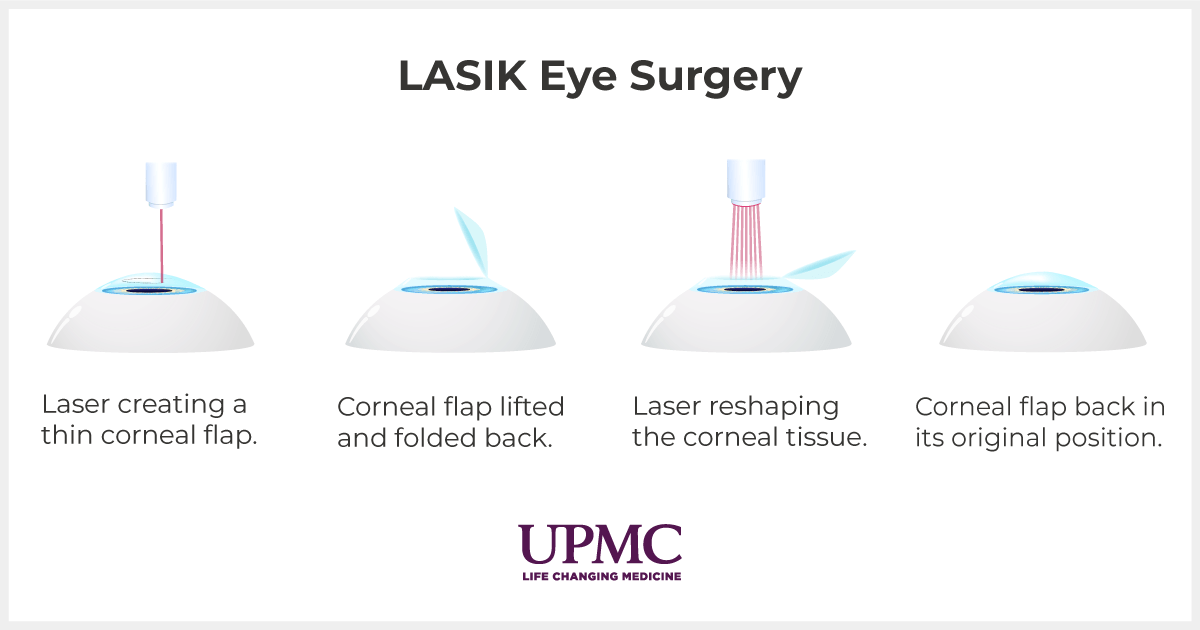
Using a laser, your eye doctor will make a paper-thin flap in the tissue of the cornea. They will lift and fold the flap back. Then, they'll reshape your cornea using a laser programmed with the specific measurements of your eye.
During the procedure, you will stare at a light so your eye doesn’t move.
After reshaping the cornea, your doctor will fold the corneal flap back down and smooth it out. It will reattach on its own in a few minutes.
Recovery after LASIK
Your doctor will give you a clear shield to put over your eyes to help protect them while they heal. They may tell you to wear the shield when you sleep, so you don’t accidentally scratch or bump your eyes.
You will need someone to drive you home after the surgery. You should spend the rest of the day relaxing or sleeping.
Your eyes may burn or itch slightly for a few hours after the procedure. Your doctor may prescribe mild pain medicine or a sedative.
Your vision may be hazy or blurry the day of the surgery, but it will usually improve by the next day.
While you are recovering, you should not:
- Drive.
- Go into a hot tub, swimming pool, or whirlpool.
- Play contact sports.
- Use creams, lotions, or eye makeup for two to four weeks after surgery.
When to call your doctor about LASIK complications
You’ll see the doctor for a follow-up appointment 24 to 48 hours after the surgery. They will remove the eye shield and examine your eyes. They will give you eye drops to prevent infection and inflammation.
You should call your eye doctor right away if you have severe pain or if your vision gets worse over time.
What’s the outcome of LASIK?
For most people, vision stabilizes within a few days after surgery. For others, it may take three to six months to see complete results.
What’s the success rate of LASIK?
According to the American Academy of Ophthalmology, 90% of people who have LASIK achieve vision between 20/20 and 20/40 without glasses or contact lenses.
A small number of people may need another surgery because their vision is under- or over-corrected. And even after a second surgery, some people may still need to wear contact lenses or eyeglasses to achieve the best vision.
One important point to remember is that LASIK cannot correct presbyopia, or age-related nearsightedness. That’s the normal loss of close-up vision that everyone gets, starting in their mid-40s. You may need reading glasses at that age, even if you’ve had LASIK.
Does insurance cover LASIK surgery?
It’s important to look at the financial cost of LASIK surgery before you commit to it. Most insurance companies consider it a cosmetic procedure and do not provide coverage.
The good news is that LASIK is usually less expensive than other vision correction procedures, such as ICL surgery. Costs vary depending on what part of the country you’re in, what surgeon you use, and how complex your case is. But in general, expect LASIK to cost at least several thousand dollars.
By UPMC Editorial Staff. Last reviewed on 2026-10-30.