What Is An Intestinal Transplant?
Intestinal transplant is a life-saving procedure for people who have intestinal failure. During the procedure, a surgeon replaces your diseased or damaged intestine with a deceased donor intestine. Although it is a rare surgery, it allows people with intestinal failure to regain the ability to eat regular food and improve their quality of life.
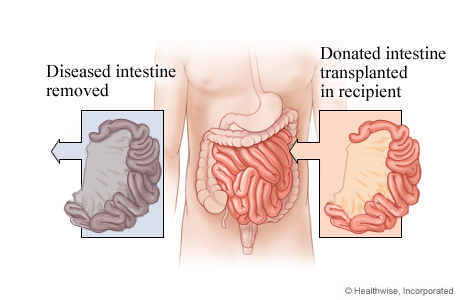
Intestinal Transplant
For an intestinal transplant, the recipient's diseased intestine is removed and replaced with the donated intestine.
© 2016-2025 Healthwise, Incorporated. This information does not replace the advice of a doctor.
Types of intestinal transplant
There are three types of intestinal transplants:
- Intestine (small bowel) only.
- Liver and intestine.
- Multivisceral, which may include the stomach, duodenum, pancreas, intestine, and liver.
Conditions we treat with intestinal transplant
Intestinal transplant is performed to treat irreversible intestinal failure caused by conditions including:
- Abdominal trauma.
- Bowel obstruction syndrome.
- Crohn’s disease.
- Desmoid or neuroendocrine tumors.
- Motility problems.
- Other gut disorders, combined with organ failure.
- Vascular occlusion.
Why Would I Need an Intestinal Transplant?
You might need an intestinal transplant if you have permanent intestinal failure and can no longer tolerate total parenteral nutrition (TPN). TPN is a treatment that supplies your body's necessary nutrients and fluids through a vein, bypassing your digestive system.
Who’s a candidate for an intestinal transplant?
Most people who receive an intestinal transplant are on total parenteral nutrition (TPN) and can no longer eat solid food. Many have had complications with TPN and other treatments haven't worked.
When possible, we will work with you to find a medical solution before recommending you as an intestinal transplant candidate. Intestinal rehabilitation cures about 70% of people referred to us.
Most people who receive an intestinal transplant have short gut syndrome or have had benign or malignant tumors.
What is short gut syndrome?
Short gut syndrome — also called short bowel syndrome — is a condition where part of the small intestine is missing. People with short gut syndrome cannot properly absorb nutrients.
People with short gut syndrome experience symptoms such as diarrhea or difficulty passing food through the digestive tract. Eventually, they are no longer able to eat solid food and end up on total parenteral nutrition (TPN).
TPN requires long stays at home or in the hospital attached to an IV line. Complications of TPN can include infection, clots, or liver cirrhosis. In these cases, an intestinal transplant may be the best treatment.
Who is not eligible for an intestinal transplant?
People who are not eligible for intestinal transplant include those with:
- Active infections.
- Cancer (must be cancer-free for five years).
- Heart or lung disease who likely can't endure surgery.
- An inability to follow your pre- and post-transplant treatment plan.
Regardless of your prognosis or the severity of your disease, you will receive personalized, high-quality care at UPMC.
Alternatives to intestinal transplant
Our surgeons are skilled in performing complex abdominal surgeries that can restore gut function without the need for intestinal transplant.
Corrective and rehabilitative treatment options for short bowel syndrome or other intestinal disorders can include various types of abdominal surgery, such as:
- Complex fistula surgery and repair of any fistulae present
- Gastric bypass surgery corrections.
- Portal hypertension surgery.
- Reconnecting the bowel with the closure of your stoma.
- Removal of adhesions.
What Are the Risks and Complications of Intestinal Transplant?
Intestinal transplant carries a higher risk of rejection and infection when compared to other organ transplant procedures. Other possible complications include:
- Blood clots or bleeding.
- Post-transplant lymphoproliferative disorder (PTLD).
- Problems with your new intestine, including blockages or narrowing.
- Side effects or complications caused by post-transplant anti-rejection medications.
What Should I Expect From Intestinal Transplant?
Your doctor will need to refer you for gastrointestinal rehabilitation by calling 412-647-5800. We will evaluate anyone who comes to our center to see if they may be an intestinal transplant candidate.
We will need your:
- Health insurance information.
- Medical history.
- Recent lab work.
After you are referred, you will meet with the intestinal transplant team to discuss the risks and benefits of surgery, as well as options for intestinal rehabilitation.
The earlier you receive a referral, the better the outcome.
Pre-intestinal transplant exams and tests
The intestinal transplant evaluation involves a series of outpatient tests, scans, and consultations.
The transplant team will review your:
- Body's ability to handle intestinal transplant surgery.
- Gastrointestinal system.
- Health history that could impact your success with the transplant.
- Mental and behavioral health.
The process takes a week to complete, and you must have a care partner with you at all appointments.
If we decide transplant is an appropriate treatment option for you, we'll work with your insurance plan to approve the surgery.
How much does an intestinal transplant cost?
The costs of intestinal transplant surgery differ depending on your insurance, but they can be very high.
A credit analyst and social worker from UPMC's intestinal transplant team will:
- Give you a packet with details about your benefits and potential out-of-pocket costs for your intestinal transplant.
- Help you find financial assistance if you can't cover the costs of your intestinal transplant.
- Work with you to understand your insurance coverage.
Waitlist
Next, we'll add you to the national intestinal transplant waiting list. Your gastroenterologist, transplant surgeon, dietitian, and nurse coordinator will manage your condition as you wait for your transplant.
You need to be able to get to UPMC Montefiore within four hours after you're placed on the national intestinal transplant waiting list. Many people drive, but some arrange private flights to Pittsburgh. Your social worker can provide you with details about flights.
Learn more about traveling to Pittsburgh for transplant services.
How long will I need to wait for a transplant?
Intestinal transplant waiting list times are hard to predict and highly variable — from one day to over a year.
Some factors that affect your wait time for an intestinal transplant include your:
- Blood type.
- Health status.
- Size and weight.
Before your intestinal transplant surgery
When an organ becomes available, your transplant coordinator will call you to come to the hospital as soon as possible. You must get to the hospital right away. We ask people on the national intestinal transplant waiting list to be within four hours of UPMC Montefiore.
Before coming to the hospital
When we call you to come for intestinal transplant surgery:
- Do not eat or drink.
- Make sure you have all of your medicines.
- Pack your cell phone and charger.
- Report to the area of the hospital that your coordinator specified.
When you arrive at the hospital
When you arrive at UPMC, we will admit you to the transplant unit, where you will prepare for intestinal transplant surgery.
The donor team will inspect the organ to make sure that it's a good match for you.
You will meet with the anesthesiologist, who will review your anesthesia plan. You will also be asked to sign consent forms for the procedure.
After the operating room is ready, you will receive anesthesia and sleep through the intestinal transplant surgery.
How long does intestinal transplant surgery take?
The length of surgery varies depending on what type of intestinal transplant you're having. The types of intestinal transplant include small bowel transplant, multivisceral transplant, and combined liver and intestinal transplant.
- Intestinal transplant —Takes about eight hours.
- Combined liver and intestinal transplant — Takes eight to 12 hours.
- Multivisceral Transplant — Takes 12 hours or more.
During your intestinal transplant surgery
What happens during your surgery depends on the type of procedure you are having. If you are having an intestinal transplant, your surgeon will remove your diseased small intestine and replace it with a healthy one from a deceased donor.
If you are having a combined liver and intestine transplant or multivisceral transplant, surgeons will remove your diseased intestine and other organs before replacing them with healthy organs. When multiple organs are transplanted at the same time, they typically come from the same deceased donor to reduce the risk of rejection.
Recovery after intestinal transplant surgery
Your hospital stay
After surgery, we will take you to our transplant intensive care unit (ICU). Most people spend about one to four days in the ICU.
You will start taking antirejection medicines right away. When your body detects something new, your immune system begins working to fight what it views as a threat. Antirejection medicines suppress your immune system's natural response to allow your body to accept the new intestine, liver, or other organs.
You will also have a feeding tube in place to transition you to a regular diet.
While in the ICU, the intestinal transplant team will:
- Adjust your antirejection medicines.
- Check for signs of infection or organ rejection.
- Monitor your condition.
- Wean you off the ventilator.
After you are stable, you will move to a patient room on the transplant floor. You should expect to spend three to four weeks in the hospital after intestinal transplant surgery.
During this time, nutrition specialists will work with you to reduce total parenteral nutrition (TPN) until you no longer need it.
Before we discharge you, we will give you a detailed diet plan and medicine schedule to follow when you get home. Be sure that you and your care partner fully understand these instructions before you leave the hospital.
Your care team is here to help you throughout the entire transplant process, so feel free to ask any questions.
Follow-up care after discharge from the hospital
Right after intestinal transplant surgery, you will need to take care of your incision (cut) site to avoid infection.
The end goal after an intestinal transplant is to eliminate your use of TPN.
Your follow-up appointment schedule
The follow-up after an intestinal transplant can take a long time. You might need to stay close to UPMC for a few weeks to several months after surgery. If you don't live near Pittsburgh, you and your caregiver can stay at Family House until you're ready to return home. It is not a medical facility.
After an intestinal transplant, you will need to come to the outpatient clinic nearly every day for the first few weeks. During these visits, we will perform lab work and biopsies. These tests look for infection or rejection.
We'll also make sure you're able to eat and drink.
After you're stronger, these visits will decrease to three times a week and then twice a week.
Recovery time after intestinal transplant varies widely for each person.
Some people can return home and reduce the frequency of follow-up visits within three months after transplant surgery. Others may take longer to recover.
Preventing intestinal transplant rejection
After an intestinal transplant, there is a risk that your body could reject your new organ. The risk for rejection is higher when compared to other organ transplants.
You will need to take antirejection medicines for the rest of your life.
You may also have prescriptions to:
- Manage pain.
- Prevent infection.
- Treat any other health issues you may have.
Call your transplant coordinator or pharmacist if you have any questions about your medicines.
Preventing infection after intestinal transplant
Being on antirejection medicines means your immune system is not functioning as well as it normally does. This increases your risk of getting infections.
Make sure that you follow good hygiene for preventing infection, and ask that any visitors do so as well. Tips to prevent infection include:
- Ask loved ones and friends to avoid visiting when they are sick.
- Avoid crowds during peak times for illness, like flu season.
- Wash your hands often.
Your care partner's role
You will not be able to drive for six weeks after intestinal transplant surgery.
You will need to have a care partner with you for the first few months to help you with your daily routine and recovery.
Your care partner will need to:
- Arrange your transportation to and from appointments.
- Help you get in and out of bed, bathe, and get dressed.
- Assist in tracking your health information to give to the intestinal transplant team.
- Make sure you take your medicines on time.
- Refill prescriptions, grocery shop, and run other errands.
- Watch for any strange behavior and contact the transplant team with concerns.
Life after intestinal transplant
Most people feel their quality of life is greatly improved after intestinal transplant. They no longer need TPN.
Although you may be able to eat what you like after your intestinal transplant, some foods can interfere with the medicines you're taking. The medications can affect your levels of potassium, phosphorus, and magnesium.
You'll need to be cautious about eating certain foods high in these nutrients to keep your levels in a healthy range.
Your nutritionist will work with you before you leave the hospital and at follow-up visits to create an eating plan based on your recovery and specific medicines.
The intestinal transplant team at UPMC is committed to being with you for the rest of your life. We're here to answer your questions or provide care any time you need it.
When to call your doctor about complications
You should let your surgeon know if you have:
- A fever of more than 100.0°F.
- Difficulty breathing.
- Numbness, tingling, pain, swelling, or weakness in your leg.
- Pain, redness, bleeding, drainage, or increased swelling at your treatment site.
- Severe pain that does not respond to medication.
What’s the survival rate after intestinal transplant?
Intestinal transplant has survival outcomes similar to other organ transplants, but it does carry a higher risk of infection and rejection. Your survival rate also depends on your condition, your overall health, and other factors.
Why Choose UPMC for Intestinal Transplant Care?
When you choose UPMC for an intestinal transplant, you will have access to:
- Expertise — Located in Pittsburgh, the Gastrointestinal Rehabilitation and Transplant Program was formally developed in 1999, at which time UPMC already had a decade of experience in performing intestinal transplants.
- Experience — Our team has performed more than 670 combined adult and pediatric intestinal and multivisceral transplants since 1990, representing more than 14 percent of the world's total intestinal transplants.
- Innovation — UPMC has been at the forefront of intestinal transplant and rehabilitation since performing the first-ever liver-intestinal transplant.
- A multidisciplinary team — Includes surgeons, gastroenterologists, dietitians, and more.
- 24/7 support — Our on-call transplant coordinator and surgeon are available at all times.
- Veteran care — Dedicated services through VA partnership.